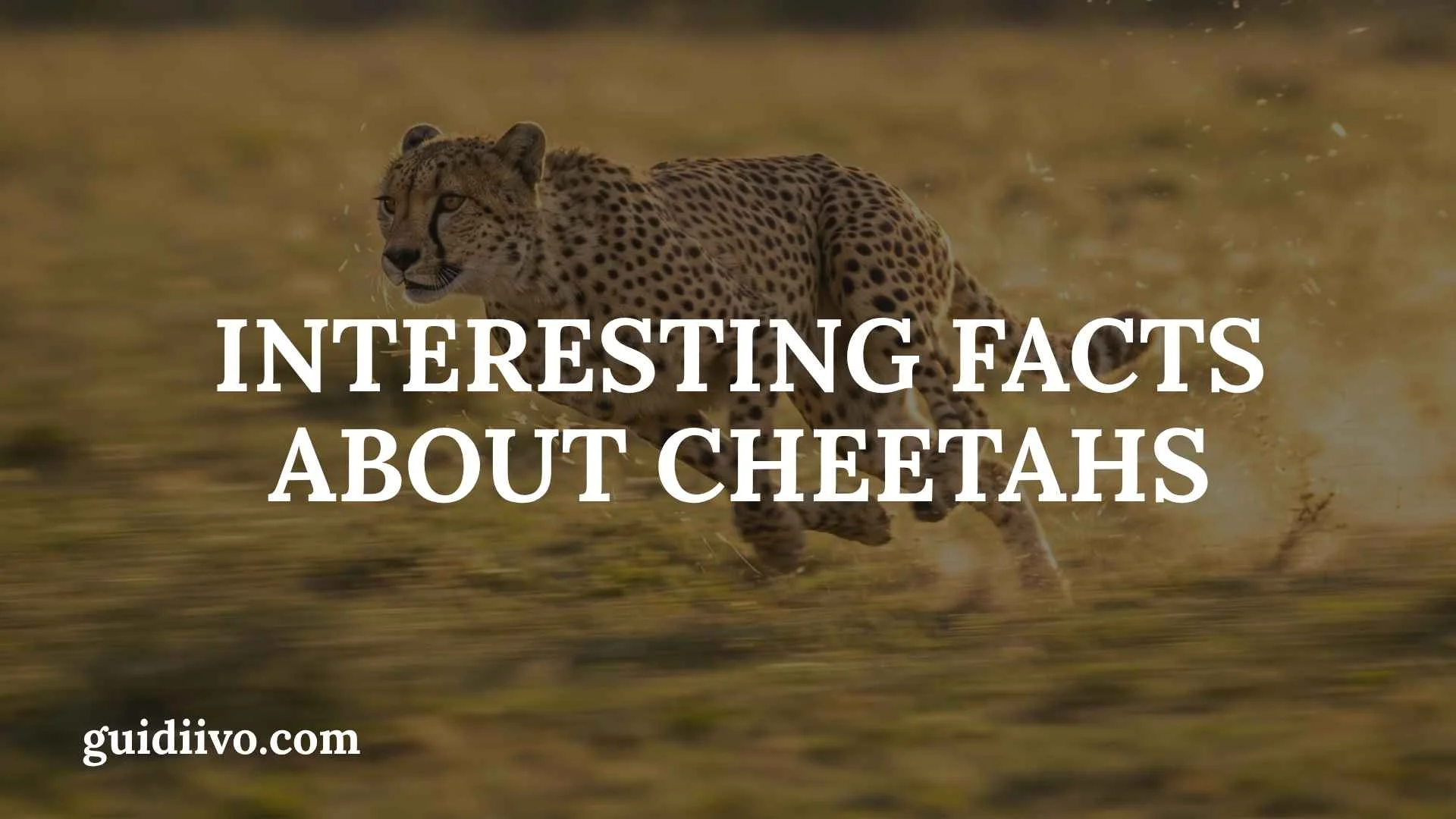
Cheetahs look almost weightless when they race across open grasslands, yet every part of their body is working at extraordinary intensity. These spotted cats can accelerate faster than many sports cars, steer with their tails, grip the ground with specialized claws, and recover from a chase within minutes.
The most interesting facts about cheetahs go far beyond speed. Cheetahs have unusual social lives, distinctive hunting methods, limited genetic diversity, and a surprisingly vulnerable place in the natural world. This guide explores their biology, behavior, history, habitat, survival challenges, and importance to modern conservation.
Quick Answer: What Are the Most Interesting Facts About Cheetahs?
Cheetahs are the fastest land animals, capable of reaching roughly 60 to 70 miles per hour for short bursts. Their flexible spines, long legs, enlarged lungs, semi-retractable claws, and balancing tails support high-speed hunting. Unlike most big cats, cheetahs cannot roar. They chirp, purr, hiss, and communicate through scent, posture, and facial expressions.
Quick Facts About Cheetahs
| Topic | Quick Fact |
| Common name | Cheetah |
| Scientific name | Acinonyx jubatus |
| Animal family | Felidae |
| Main range | Sub-Saharan Africa, with a tiny remnant population in Iran |
| Preferred habitat | Grasslands, savannas, dry forests, scrublands, and deserts |
| Adult body length | About 3.6 to 4.9 feet, excluding the tail |
| Tail length | About 2 to 2.8 feet |
| Adult weight | Commonly 75 to 140 pounds |
| Top speed | Roughly 60 to 70 miles per hour in short bursts |
| Gestation | About three months |
| Typical litter | Three to six cubs |
| Wild lifespan | Commonly around 8 to 12 years |
| Conservation status | Vulnerable, with a decreasing population trend |
| Famous feature | Black “tear marks” running from the eyes toward the mouth |
1. Cheetahs Are the Fastest Land Animals
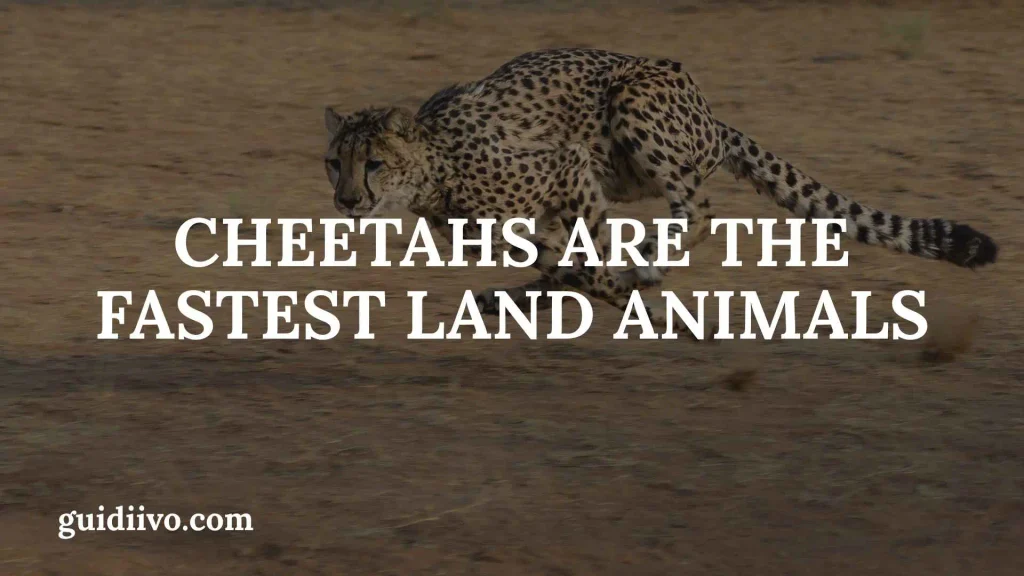
A cheetah can reach approximately 60 to 70 miles per hour during a short sprint. However, speed records vary because wild animals do not run under controlled conditions like racing vehicles.
Why it matters: Speed allows cheetahs to catch agile prey in open landscapes where hiding places are limited.
Did you know? A cheetah cannot maintain its highest speed for long. Most chases last less than a minute because sprinting generates enormous heat and uses energy rapidly.
2. Their Acceleration Is More Impressive Than Their Top Speed
Cheetahs can move from a slow start to highway-level speed within only a few seconds. Powerful hind legs drive the body forward while the spine stretches and contracts like a spring.
Why it matters: Prey usually starts running before a cheetah reaches full speed, so rapid acceleration is essential.
Did you know? Successful hunting depends on timing, distance, terrain, and positioning. A poorly timed sprint wastes precious energy even when the cheetah is physically capable of catching the animal.
3. Cheetahs Usually Hunt Below Their Maximum Speed
Wild cheetahs do not simply run as fast as possible in every chase. They must balance speed with control, turning ability, and awareness of the prey’s movement.
Why it matters: An animal moving at maximum speed becomes less able to make sharp turns.
Did you know? Researchers studying predator-prey movement have found that maneuverability and deceleration can be just as important as raw speed. Cheetahs often adjust their pace so they can follow zigzagging prey.
4. A Flexible Spine Acts Like a Powerful Spring
During a sprint, a cheetah’s spine bends and extends dramatically. At one moment, all four legs gather beneath the body. A moment later, the body stretches forward with the legs spread apart.
Why it matters: This motion increases stride length and helps the animal cover more ground with every step.
Did you know? At certain points in the running cycle, none of the cheetah’s feet touch the ground. This airborne phase occurs both when the body is fully extended and when it is tightly gathered.
5. Their Claws Work Like Running Spikes
Most cats fully retract their claws when walking. Cheetahs have claws that remain partly exposed, giving them extra traction on soil and grass.
Why it matters: Better grip reduces slipping during acceleration, braking, and sudden turns.
Did you know? The scientific name Acinonyx is often interpreted as referring to a claw that does not move or retract in the typical feline way. The feature makes a cheetah’s foot function more like a runner’s shoe than a silent stalking paw.
6. Their Paw Pads Are Hard and Grooved
Cheetah paw pads are tougher and less rounded than those of many other cats. Their ridged surfaces help the animal hold the ground during high-speed movement.
Why it matters: Acceleration is useless without traction. Specialized paw pads transfer muscular force into forward motion.
Did you know? The tradeoff is reduced climbing ability. Cheetahs can climb low trees, fallen trunks, and termite mounds, but they are not as powerful or comfortable in trees as leopards.
7. A Cheetah’s Tail Functions as a Counterbalance
The long, muscular tail moves from side to side while a cheetah runs. It helps stabilize the body as the animal follows prey through sudden changes in direction.
Why it matters: Without balance, a high-speed turn could cause a dangerous fall.
Did you know? The tail does not act exactly like a simple boat rudder. It shifts angular momentum and helps control body orientation, making it part of a complex system involving the spine, limbs, inner ear, muscles, and nervous system.
8. Cheetahs Can Brake Extremely Quickly
A chase is not only about gaining speed. Cheetahs must also slow down before colliding with obstacles, overshooting prey, or losing control.
Why it matters: Rapid deceleration allows the hunter to match an animal that suddenly stops or turns.
Did you know? The cheetah’s athletic advantage includes acceleration, braking, and steering. Focusing only on its maximum speed overlooks the full set of abilities that make it an effective pursuit predator.
9. Their Bodies Are Built More Like Racing Machines Than Heavy Fighters
Cheetahs have slender bodies, narrow waists, deep chests, small heads, and relatively lightweight frames. They are far less muscular than lions and generally lighter than adult leopards.
Why it matters: A light body requires less energy to accelerate.
Did you know? This design has a cost. Cheetahs are poorly equipped to defend kills against stronger predators. Lions, leopards, hyenas, and even groups of vultures may pressure them away from food.
10. Enlarged Airways Help Supply Oxygen
Cheetahs have large nostrils, enlarged nasal passages, powerful lungs, and strong hearts. These systems support the rapid delivery of oxygen during intense movement.
Why it matters: Sprinting muscles need oxygen and fuel while producing heat and metabolic waste.
Did you know? Their small canine teeth leave more room in the skull for enlarged air passages. This is another evolutionary tradeoff because smaller canines may offer less fighting power than the larger teeth of heavier cats.
11. Their Breathing Rate Rises Dramatically After a Chase
A resting cheetah breathes at an ordinary pace, but after a demanding sprint it may pant heavily while recovering.
Why it matters: Panting helps restore oxygen balance and release heat.
Did you know? A cheetah may rest before eating, especially after a difficult chase. This pause creates a vulnerable period when other predators can approach and steal the kill.
12. Black Tear Marks May Reduce Glare
Two dark lines run from the inner corners of a cheetah’s eyes toward the sides of its mouth. These markings may help reduce glare from bright sunlight, although visual communication may also play a role.
Why it matters: Cheetahs often hunt during daylight and rely heavily on sharp vision.
Did you know? The marks make cheetahs easy to distinguish from leopards. Leopards have rosette-shaped coat patterns and usually lack the same bold facial lines.
13. Every Cheetah Has a Unique Spot Pattern
A cheetah’s coat is covered with solid black spots. The precise arrangement differs from one animal to another.
Why it matters: Researchers can identify individual cheetahs by studying photographs from camera traps and field surveys.
Did you know? Computer programs can compare spot patterns across thousands of images. This noninvasive method helps scientists estimate population size, track movements, and record which individuals survive from one year to the next.
14. Cheetahs Are Not Built to Roar
Cheetahs cannot produce the deep roar associated with lions, tigers, leopards, and jaguars. Their throat anatomy is structured differently.
Why it matters: The difference reflects their evolutionary relationship and communication style.
Did you know? Cheetahs are still highly vocal. Their calls include chirps, growls, hisses, moans, stutters, and purrs. A loud chirping call can help separated mothers and cubs locate one another.
15. Cheetahs Can Purr
A relaxed cheetah may produce a steady purring sound similar to that of a domestic cat. Purring occurs during friendly contact, resting, feeding, and interactions between mothers and cubs.
Why it matters: It shows that large body size does not determine whether a cat roars or purrs.
Did you know? Cheetahs may purr during both inhalation and exhalation, creating a nearly continuous vibration. They can also switch quickly from peaceful purring to defensive hissing when threatened.
16. Male Cheetahs Often Form Coalitions
Male cheetahs frequently live in small groups called coalitions. These groups commonly include brothers from the same litter, although unrelated males may occasionally join.
Why it matters: Coalition members can defend territory, compete for access to females, and sometimes hunt larger prey together.
Did you know? A lone male may control a smaller or less valuable area than a stable coalition. Cooperation helps compensate for the cheetah’s relatively light and vulnerable body.
17. Female Cheetahs Usually Live Alone
Adult females are generally solitary except when raising cubs. Their ranges may be very large because they follow prey and search for safe places to rest.
Why it matters: Female movement patterns make cheetah conservation difficult. Protecting one small reserve may not preserve enough connected habitat.
Did you know? A female may pass through several male territories. Unlike territorial males, she often moves according to food availability rather than defending a fixed core area.
18. Cheetah Territories Can Be Surprisingly Complex
Some males defend small, high-value territories near routes frequently used by females. Other males roam across broad areas without holding a permanent territory.
Why it matters: Social organization changes with prey density, water, habitat, competition, and the distribution of females.
Did you know? Cheetahs mark locations with urine, feces, claw marks, and scent. Prominent trees or rocks may become communication centers visited by several animals.
19. They Prefer to Hunt During Daylight
Cheetahs often hunt in the morning or late afternoon. In some places, they also hunt around midday when lions and hyenas are less active.
Why it matters: Choosing a quieter time can reduce competition with larger predators.
Did you know? Human activity can alter this schedule. Cheetahs living near livestock areas may become more nocturnal to avoid people, although darkness can expose them to predators that are better adapted for nighttime hunting.
20. Vision Is Central to Cheetah Hunting
Cheetahs usually scan the landscape from raised ground, termite mounds, low tree branches, or other viewpoints. Once they locate prey, they use cover to approach before sprinting.
Why it matters: Beginning the chase at a manageable distance saves energy and improves success.
Did you know? Cheetahs rely more on eyesight than scent when actively searching for prey. Their hunting strategy combines patient observation, careful stalking, explosive pursuit, and precise control.
21. Cheetahs Do Not Simply Outrun Every Animal
Several prey species can escape by turning sharply, separating from the herd, reaching cover, or maintaining distance until the cheetah tires.
Why it matters: A high top speed does not guarantee a successful hunt.
Did you know? Young, injured, distracted, or poorly positioned prey may be easier targets. Cheetahs often select vulnerable individuals because hunting always carries a risk of exhaustion or injury.
22. A Cheetah Usually Trips Its Prey
Near the end of a chase, a cheetah may strike the prey’s hindquarters or legs with a front paw. Once the animal falls, the cheetah uses a throat hold to suffocate it.
Why it matters: The technique allows a lightly built predator to bring down prey without wrestling for long.
Did you know? The method is risky. A kick from an antelope can break bones, damage teeth, or cause internal injury.
23. Their Favorite Prey Is Usually Medium-Sized and Fast
Common prey includes gazelles, impalas, springbok, young wildebeest, hares, and other animals suited to the local environment.
Why it matters: Cheetahs need prey that is large enough to provide food but small enough to overpower safely.
Did you know? Diet varies by region. A coalition can sometimes tackle larger animals than a solitary female because several males can chase, restrain, and defend the meal together.
24. Mothers Raise Cubs Without Help From Males
After a gestation of about three months, a female usually gives birth in thick vegetation or another sheltered location. Litters commonly contain three to six cubs.
Why it matters: The mother must hunt, nurse, protect, and teach the cubs alone.
Did you know? She moves young cubs between hiding places to reduce scent buildup and lower the risk of predators finding the den.
25. Cheetah Cubs Have a Silvery Mantle
Young cubs develop long, pale hair along the neck and back. This coat, called a mantle, makes them look very different from adults.
Why it matters: The mantle may provide camouflage by breaking up the cub’s outline in dry grass.
Did you know? Some people have suggested that it makes cubs resemble honey badgers, which many predators avoid. This idea is intriguing, but camouflage and insulation remain more widely accepted explanations.
26. Cub Mortality Can Be Very High
Cheetah cubs face danger from lions, hyenas, leopards, birds of prey, starvation, disease, fire, and exposure. Mortality rates vary greatly among habitats.
Why it matters: A female may raise only a small portion of her cubs to independence even after investing months in their care.
Did you know? Dense predator populations can make otherwise suitable habitat dangerous for cheetah families.
27. Cubs Learn Through Practice and Observation
As cubs grow, they follow their mother and watch her hunt. She may bring live or partly disabled prey so they can practice chasing and controlling it.
Why it matters: Hunting is not purely instinctive. Young cheetahs need experience to judge distance, select targets, and coordinate their movements.
Did you know? Siblings may remain together briefly after leaving their mother. Females eventually separate, while brothers often stay together as a coalition.
28. Cheetahs Have Unusually Low Genetic Diversity
Modern cheetahs are genetically similar compared with many other mammals. Scientists connect this pattern to severe population reductions in their evolutionary history.
Why it matters: Low genetic diversity may reduce reproductive success and limit the ability of populations to adapt to disease or environmental change.
Did you know? Genetics is only one threat. Habitat loss, fragmented populations, conflict with livestock owners, illegal trade, and declining prey can be more immediate causes of local disappearance.
29. Cheetahs Once Lived Across a Much Larger Region
Historically, cheetahs occurred across much of Africa and through parts of the Middle East and South Asia. Today, most survive in scattered African populations, with a tiny Asiatic population remaining in Iran.
Why it matters: Their modern map represents only a fraction of their former range.
Did you know? Fragmentation separates breeding populations. Even protected groups may decline if animals cannot move safely between habitats.
30. Most Wild Cheetahs Do Not Live Only Inside Parks
A large share of the surviving population lives in landscapes shared with farmers, herders, roads, settlements, and livestock. Cheetah Conservation Fund reports that more than 75 percent occur on rural farmlands alongside people.
Why it matters: Conservation cannot depend solely on fenced reserves.
Did you know? Livestock-protection dogs, better animal enclosures, compensation programs, and improved herding can reduce retaliatory killing.
31. Cheetahs Usually Avoid Fighting Larger Predators
Rather than challenge a lion, leopard, or group of hyenas, a cheetah will often retreat.
Why it matters: Avoidance protects the cheetah from injuries that could prevent future hunting.
Did you know? Losing a meal is costly, but an injured leg can be fatal. Evolution favors survival over defending every kill, especially for a predator whose success depends on perfect movement.
32. The Asiatic Cheetah Is Close to Disappearing
The Asiatic cheetah, Acinonyx jubatus venaticus, survives only in Iran and is among the world’s rarest large cats. Exact counts are difficult because individuals travel through remote desert and mountain landscapes.
Why it matters: The loss of this population would end the cheetah’s natural presence in Asia.
Did you know? Asiatic cheetahs once occurred from the Arabian Peninsula through Iran, Central Asia, Pakistan, and India.
33. Humans Once Trained Cheetahs for Hunting
Royal courts in parts of Africa, the Middle East, Central Asia, and India kept trained cheetahs for hunting antelope and other game.
Why it matters: The practice shaped the cheetah’s cultural history but did not create true domestication.
Did you know? Captive cheetahs reproduced poorly, so rulers repeatedly removed animals from the wild. Historical demand may have contributed to regional population decline.
34. Cheetahs Play an Important Ecological Role
As predators, cheetahs influence prey behavior and remove some vulnerable animals from populations. They also provide food for scavengers when remains are left behind.
Why it matters: Predator communities help shape healthy ecosystems through many connected interactions.
Did you know? Cheetahs share landscapes with competing carnivores rather than controlling the ecosystem alone. Their role changes according to prey, climate, habitat, and the presence of other predators.
35. Protecting Cheetahs Requires Protecting Entire Landscapes
Saving cheetahs means preserving prey, migration routes, open habitat, genetic connections, and tolerance among local communities.
Why it matters: A single animal may travel far beyond a reserve boundary.
Did you know? Conservation programs increasingly combine science with practical support for farmers. Protecting livestock, restoring habitat, monitoring individuals, and preventing illegal trade can benefit both people and wildlife.
Cheetah History and Conservation Timeline
| Period | Important Milestone |
| Millions of years ago | Early cheetah-like cats evolved and spread across parts of the Northern Hemisphere |
| Late prehistoric period | Population bottlenecks contributed to low genetic diversity |
| Ancient era | Cheetahs appeared in art and were kept by rulers for coursing hunts |
| Medieval to early modern era | Royal hunting cheetahs were used across parts of Asia, Africa, and Europe |
| 1940s | India’s last widely documented native cheetahs disappeared |
| 1952 | India officially declared the cheetah extinct within the country |
| 1970s onward | Scientific field studies expanded knowledge of cheetah ecology and social behavior |
| 1990 | Cheetah Conservation Fund was established in Namibia |
| 21st century | GPS collars, genetic testing, and camera traps improved population monitoring |
| 2022 | India began a controversial African cheetah introduction project at Kuno National Park |
| Present | Conservation focuses on connected habitat, coexistence, genetics, prey protection, and control of illegal trade |
Cheetah Statistics
| Measurement | Typical Figure |
| Maximum reported sprint speed | About 60 to 70 mph |
| Length of top-speed burst | Usually less than one minute |
| Adult weight | Approximately 75 to 140 pounds |
| Shoulder height | Roughly 26 to 37 inches |
| Body length without tail | About 3.6 to 4.9 feet |
| Tail length | About 2 to 2.8 feet |
| Gestation period | About 90 to 95 days |
| Common litter size | Three to six cubs |
| Age at sexual maturity | Roughly 18 to 23 months |
| Typical wild lifespan | Around 8 to 12 years |
| Maximum lifespan in managed care | Often 15 years or more |
| Conservation category | Vulnerable |
| Population trend | Decreasing |
Measurements differ by sex, subspecies, habitat, research method, and individual condition. Population estimates also change as surveys improve, so numerical totals should be treated as informed estimates rather than exact counts.
Cheetah Myths vs. Facts
| Myth | Fact |
| Cheetahs can run at top speed for miles | They maintain their highest speeds only for short bursts |
| Speed alone guarantees a kill | Positioning, acceleration, steering, braking, and timing are equally important |
| Cheetahs are simply skinny leopards | They belong to a distinct genus and have specialized anatomy and behavior |
| All large cats roar | Cheetahs cannot roar, but they purr, chirp, hiss, and growl |
| Cheetahs always live alone | Females are usually solitary, while males often form coalitions |
| Their claws never retract at all | Their claws are best described as semi-retractable or only partly retractable |
| Every cheetah lives in protected parks | Many survive on farmland and other human-used landscapes |
| They regularly attack humans | Wild cheetahs usually avoid people and are not known as habitual human hunters |
| Cubs are miniature versions of adults | Cubs possess a long, pale mantle that adults lose |
| Conservation only means stopping poachers | Habitat, livestock conflict, prey loss, roads, genetics, and illegal trade all matter |
Common Misconceptions About Cheetahs
Cheetahs Are Not the Fastest Animals on Earth
They are the fastest land animals, but some birds achieve higher speeds in flight. Peregrine falcons can exceed 200 miles per hour during hunting dives. Sailfish and other marine animals are also often discussed in speed comparisons, although accurate underwater measurements are difficult.
Cheetahs Are Not Powerful Big-Cat Fighters
They are highly specialized athletes, not heavyweight combatants. A cheetah’s light frame supports acceleration but offers less strength during conflicts. This explains why the animal frequently abandons food when lions, leopards, or hyenas approach.
One Population Number Cannot Tell the Whole Story
Global estimates may hide severe local decline. A species can retain thousands of individuals yet remain vulnerable if those animals are separated into small groups. Roads, fences, farms, conflict zones, and unsuitable habitat can prevent movement and breeding.
A Protected Area Is Not Automatically Safe
Reserves may contain lions and hyenas that kill cubs or steal food. A park can also be too small for wide-ranging animals. Effective protection requires connected landscapes, sufficient prey, careful management, and cooperation beyond reserve boundaries.
Why Cheetahs Matter Today
Cheetahs are indicators of broad, connected ecosystems. When cheetahs disappear, the cause often involves declining prey, habitat conversion, blocked movement routes, human-wildlife conflict, or an unbalanced predator community.
Their conservation also tests whether humans can share working landscapes with large carnivores. Many cheetahs live outside national parks, so their survival depends on farmers, herders, governments, scientists, and local communities working together.
Cheetahs also inspire advances in biomechanics. Their acceleration, spinal movement, traction, tail control, and rapid turning have influenced research in robotics, vehicle design, prosthetics, and animal movement.
Related Cheetah Discoveries and Concepts
Cheetah research connects with several important fields:
- Biomechanics: How flexible spines, long limbs, claws, muscles, and tails produce controlled speed.
- Population genetics: How historical bottlenecks affect fertility, disease response, and conservation planning.
- Predator-prey ecology: How speed, terrain, behavior, and decision-making determine hunting outcomes.
- Landscape connectivity: How wildlife corridors allow movement between separated populations.
- Human-wildlife coexistence: How livestock protection and community support reduce conflict.
- Camera-trap identification: How unique spots help researchers track individuals without capture.
- Reintroduction science: How health, genetics, prey, climate, and local acceptance influence releases.
- Illegal wildlife trade: How demand for foreign pets threatens cubs in the Horn of Africa.
Expert Insights: Understanding the Cheetah Beyond Its Speed
Specialization Creates Both Strength and Vulnerability
The cheetah’s body is exceptional because it is so specialized. Long legs, light bones, enlarged airways, hard paw pads, and a flexible spine make rapid pursuit possible. Those same features limit fighting strength, climbing ability, and protection against injuries.
Behavior Is as Important as Anatomy
A cheetah does not succeed merely because it owns a fast body. It must choose the right prey, approach without being detected, begin the sprint at the proper distance, anticipate turns, avoid obstacles, and finish the hunt safely.
Conservation Must Follow the Animal’s Movement
Cheetahs do not recognize park borders. Wide-ranging females and roaming males may cross ranches, highways, fences, and national boundaries. Conservation plans must therefore connect habitats rather than protect isolated pockets.
Local People Are Essential Conservation Partners
Communities living near cheetahs often bear the cost of livestock losses. Long-term protection becomes more realistic when programs provide reliable livestock-guarding methods, economic benefits, training, and fast responses to conflict.
Frequently Asked Questions About Cheetahs
What is the most interesting fact about a cheetah?
Its speed comes from an entire system rather than one body part. A flexible spine, long limbs, enlarged airways, hard paw pads, semi-retractable claws, a muscular tail, rapid acceleration, and exceptional braking work together. This makes the cheetah a master of controlled pursuit, not merely a fast runner.
How fast can a cheetah really run?
A cheetah can reach approximately 60 to 70 miles per hour during a short burst. Exact speeds differ among individuals and conditions. Wild cheetahs usually hunt below their theoretical maximum because they need enough control to turn, brake, avoid obstacles, and follow unpredictable prey.
How long can a cheetah run at full speed?
A cheetah can maintain an intense sprint for only a short period, often less than a minute. The effort consumes energy quickly and produces substantial heat. Most hunts therefore depend on approaching close enough before accelerating, rather than beginning a long-distance race across the landscape.
Why do cheetahs have black lines on their faces?
The dark tear-shaped lines may reduce glare and improve visual contrast in bright environments. They may also contribute to recognition or communication. Their exact purpose is difficult to prove through direct experiments, so glare reduction is a strong explanation rather than an absolute certainty.
Can cheetahs climb trees?
Cheetahs can climb low, sloping trees, fallen trunks, rocks, and termite mounds, especially when young. However, they are not skilled tree climbers like leopards. Their claws and lightweight bodies are designed mainly for traction and running rather than gripping bark and carrying prey into branches.
Are cheetahs dangerous to humans?
Wild cheetahs generally avoid humans and are not known as regular human hunters. However, they remain powerful predators with sharp teeth and claws. People should never approach, feed, corner, or attempt to touch a wild cheetah. Habituated or captive animals also require professional care.
Why can cheetahs not roar?
Cheetahs have a different voice-box and throat structure from roaring cats such as lions and tigers. Instead of producing a true roar, they communicate through chirps, purrs, hisses, growls, moans, and stutter-like calls. Their chirps can travel considerable distances and help separated animals reconnect.
What is a group of cheetahs called?
A group of male cheetahs is commonly called a coalition. Coalition members are often brothers that remain together after leaving their mother. They cooperate in holding territory and may hunt together. Adult females usually live alone except while caring for dependent cubs.
Why are cheetahs endangered or vulnerable?
Major threats include habitat loss, fragmented populations, declining prey, conflict with livestock owners, road deaths, illegal pet trafficking, and competition with larger predators. Low genetic diversity adds concern, but cheetah survival also depends heavily on connected landscapes and peaceful coexistence with people.
How are cheetahs different from leopards?
Cheetahs are slimmer, faster, and mainly active during daylight. They have solid round spots, black facial tear marks, long legs, and semi-retractable claws. Leopards are heavier, stronger climbers with rosette-shaped markings. Leopards often ambush prey and may carry kills into trees, while cheetahs specialize in open-ground pursuit.
Key Takeaways
- Cheetahs are the fastest land animals, but they can sprint at top speed only briefly.
- Acceleration, steering, braking, and decision-making matter as much as maximum speed.
- Their flexible spines, long legs, large airways, hard paw pads, and semi-retractable claws support rapid movement.
- Long tails help stabilize the body during sudden turns.
- Cheetahs cannot roar, but they can purr, chirp, hiss, growl, and moan.
- Male cheetahs often form coalitions, while adult females usually live alone.
- Mothers raise cubs without help from males.
- Many cubs die before reaching independence.
- Cheetahs have unusually low genetic diversity.
- Most remaining populations are fragmented.
- Many wild cheetahs live outside national parks on human-used land.
- Protecting the species requires habitat connections, healthy prey populations, conflict reduction, and community involvement.
Conclusion
The most interesting facts about cheetahs reveal an animal shaped by remarkable tradeoffs. Its light body, flexible spine, gripping claws, long tail, and enlarged respiratory system create breathtaking speed, yet the same specialization leaves it vulnerable to injuries, stronger predators, habitat fragmentation, and human conflict.
Cheetahs are not simply spotted cats that run fast. They are skilled decision-makers, devoted mothers, cooperative brothers, important predators, and living examples of evolutionary specialization. Protecting them means preserving not only one famous species but also the open landscapes, prey communities, and human partnerships that allow wildlife to survive.

I am Theodore Blake, a writer driven by curiosity and a lifelong love of discovery. I enjoy exploring surprising facts about animals, science, history, and the natural world. Through my writing, I aim to make knowledge simple, enjoyable, and memorable while inspiring readers to see familiar subjects from new perspectives.
Books
1. The Curious World: Extraordinary Facts Explained
A fascinating collection of unusual facts about nature, science, history, and everyday life, written to entertain curious readers.
2. Hidden Wonders: Stories Behind Amazing Facts
This book explores surprising discoveries and little-known stories that reveal how extraordinary our world truly is.