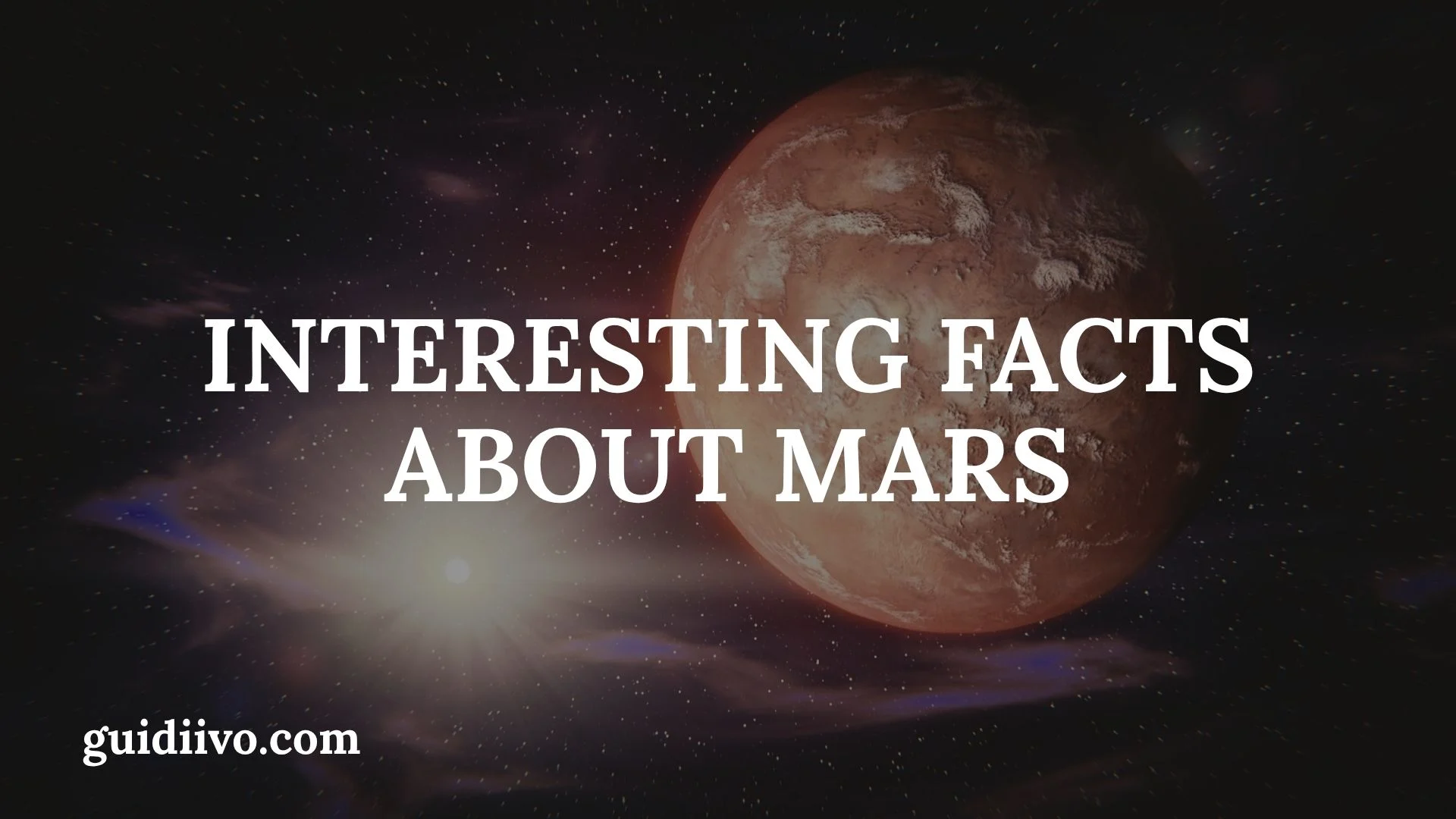
Mars is a cold desert today, but its dusty surface preserves evidence of a far more dramatic past. Ancient rivers crossed its landscapes, lakes filled its craters, volcanoes reshaped its crust, and floods carved enormous channels.
These interesting facts about Mars explain why the Red Planet remains one of the most studied places beyond Earth. You will learn how Mars formed, why it looks red, where its water went, what robotic explorers have discovered, and whether life could once have existed there.
You will also discover record-breaking mountains, unusual sunsets, planet-wide dust storms, marsquakes, mysterious moons, and the difficult realities of sending humans to another planet.
Quick Answer:Interesting Facts About Mars
Mars is the fourth planet from the Sun and the second-smallest planet in the solar system. It is a rocky, cold, dusty world with two small moons, enormous volcanoes, deep canyons, polar ice caps, and strong evidence of ancient rivers and lakes. Scientists study Mars because it may once have offered conditions suitable for microbial life.
Quick Facts About Mars
| Topic | Mars Fact |
| Category | Terrestrial, or rocky, planet |
| Location | Fourth planet from the Sun |
| Common Name | The Red Planet |
| Age | About 4.5 billion years |
| Average Diameter | About 6,779 kilometers, or 4,212 miles |
| Average Distance From the Sun | About 228 million kilometers, or 142 million miles |
| Length of Day | 24 hours, 39 minutes, 35 seconds |
| Length of Year | 687 Earth days |
| Number of Moons | Two: Phobos and Deimos |
| Surface Gravity | About 38 percent of Earth’s gravity |
| Atmosphere | Mostly carbon dioxide |
| Average Temperature | About -63°C, or -81°F |
| Highest Mountain | Olympus Mons |
| Largest Canyon System | Valles Marineris |
| Known Population | No confirmed living organisms |
| Fun Fact | A Martian sunset usually appears bluish near the Sun |
Interesting Facts About Mars
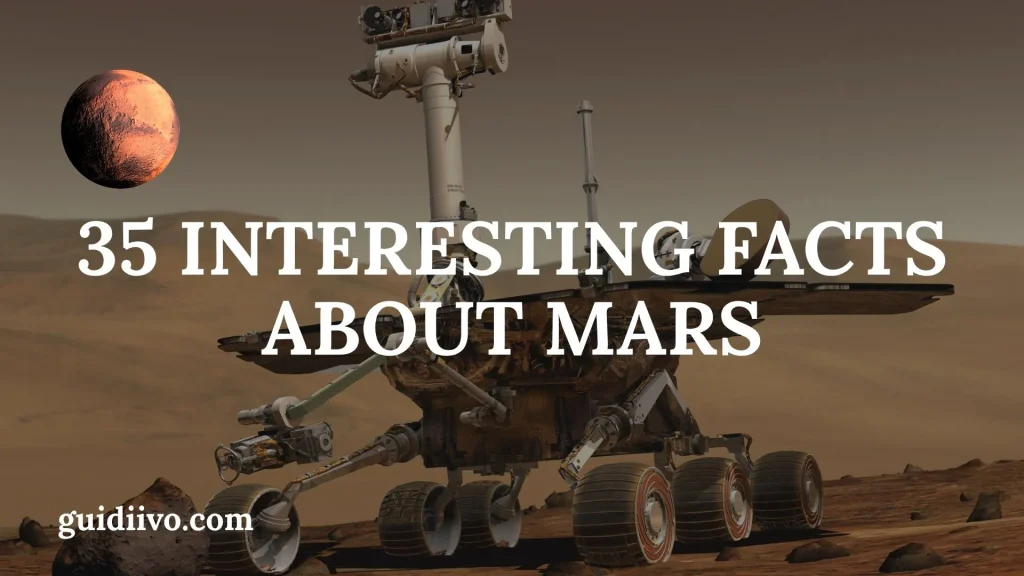
Fact 1: Mars Is the Fourth Planet From the Sun
The fact: Mars travels around the Sun between Earth and Jupiter. Its average orbital distance is about 228 million kilometers, or 142 million miles.
Why it matters: This greater distance means Mars receives less sunlight and heat than Earth.
Did you know? The distance between Earth and Mars constantly changes because both planets follow separate elliptical orbits.
Additional context: Depending on their positions, the two planets may be less than 60 million kilometers apart or more than 400 million kilometers apart.
Fact 2: Iron Minerals Make Mars Look Red
The fact: Mars appears reddish because iron-bearing minerals in its rocks and soil reacted with oxygen and formed iron oxides, similar to rust.
Why it matters: The color reveals important information about the planet’s chemistry and geological history.
Did you know? Martian soil is not equally red everywhere. Some exposed rocks appear gray, brown, black, or greenish.
Additional context: Fine iron-rich dust spreads through the atmosphere and coats much of the surface, giving the entire planet its rusty appearance from space.
Fact 3: Mars Is About Half the Diameter of Earth
The fact: Mars has an average diameter of approximately 6,779 kilometers, while Earth’s diameter is about 12,742 kilometers.
Why it matters: A smaller planet cools more quickly because it loses internal heat faster.
Did you know? Mars has roughly the same amount of dry land as Earth because oceans cover most of Earth’s surface.
Additional context: Its smaller size helped shape its geological development, atmosphere, magnetic history, and ability to retain liquid surface water.
Fact 4: Mars Has Only About 38 Percent of Earth’s Gravity
The fact: A person who weighs 150 pounds on Earth would weigh about 57 pounds on Mars, although that person’s mass would remain unchanged.
Why it matters: Lower gravity affects human movement, bones, muscles, fluids, buildings, and spacecraft landings.
Did you know? You could jump higher on Mars, but a spacesuit would restrict your movement.
Additional context: Scientists do not yet know exactly how years of Martian gravity would affect the human body because no person has experienced it.
Fact 5: A Day on Mars Feels Surprisingly Familiar
The fact: One Martian solar day lasts about 24 hours, 39 minutes, and 35 seconds. Scientists call it a “sol.”
Why it matters: Mars has one of the most Earth-like day lengths in the solar system.
Did you know? Rover teams sometimes organize their work according to Martian time during the early stages of a mission.
Additional context: The extra 39 minutes cause the Martian workday to shift against Earth clocks, making sleep schedules challenging for mission controllers.
Fact 6: A Martian Year Lasts 687 Earth Days
The fact: Mars takes approximately 687 Earth days to complete one orbit around the Sun.
Why it matters: Each Martian year is almost twice as long as an Earth year.
Did you know? Someone celebrating annual birthdays on Mars would wait nearly 23 Earth months between them.
Additional context: Mars also moves at different speeds during its orbit because the orbit is more elongated than Earth’s, creating uneven seasonal lengths.
Fact 7: Mars Has Four Seasons
The fact: Mars experiences spring, summer, fall, and winter because its rotational axis is tilted by about 25 degrees, close to Earth’s 23.5-degree tilt.
Why it matters: The tilt produces changing temperatures, frost, clouds, winds, and polar ice.
Did you know? Seasons last longer in the northern hemisphere than in the southern hemisphere.
Additional context: Mars follows an elliptical orbit, so southern summers are shorter and warmer, while northern summers are longer and generally cooler.
Fact 8: Mars Has a Very Thin Atmosphere
The fact: The Martian atmosphere consists mainly of carbon dioxide, with smaller amounts of nitrogen, argon, oxygen, carbon monoxide, and water vapor.
Why it matters: Its low pressure prevents stable liquid water from remaining exposed across most of the surface.
Did you know? Surface pressure is generally less than one percent of Earth’s sea-level pressure.
Additional context: A human would need a pressurized spacesuit with oxygen. Carbon dioxide alone cannot support human breathing, even when it surrounds a person.
Fact 9: Mars Is Extremely Cold
The fact: The average surface temperature is approximately -63°C, or -81°F, although temperatures vary greatly by season, time, and location.
Why it matters: Severe cold creates major engineering problems for batteries, electronics, spacesuits, habitats, and water systems.
Did you know? Sunny equatorial ground may briefly rise above freezing, while polar winter temperatures can drop below -120°C.
Additional context: The thin atmosphere cannot store and distribute heat efficiently, producing large temperature differences between day and night.
Fact 10: Olympus Mons Is the Solar System’s Largest Known Volcano
The fact: Olympus Mons rises roughly 22 kilometers above the surrounding plains and spreads about 600 kilometers across.
Why it matters: Its immense size reveals how long volcanic activity could continue in one region of Mars.
Did you know? The volcano is so wide that a person standing near its base could not see its summit because of the planet’s curvature.
Additional context: Mars lacks active plate tectonics like Earth’s, so a volcano could remain above a hot spot and accumulate layer after layer of lava.
Fact 11: Olympus Mons Has Gentle Slopes
The fact: Although Olympus Mons is extremely tall, it is a shield volcano with broad slopes that rise gradually.
Why it matters: Its shape shows that it formed mainly from repeated flows of fluid lava rather than highly explosive eruptions.
Did you know? The average slope is only a few degrees across much of the volcano.
Additional context: Its summit contains several overlapping calderas. These large depressions formed when underground magma chambers emptied and the ground above them collapsed.
Fact 12: Valles Marineris Dwarfs Earth’s Grand Canyon
The fact: Valles Marineris stretches for more than 4,000 kilometers, reaches hundreds of kilometers across, and descends several kilometers in places.
Why it matters: It exposes deep layers of Martian crust that record volcanic, tectonic, erosional, and possibly watery processes.
Did you know? Placed on Earth, the canyon system could extend across the continental United States.
Additional context: It probably began as fractures connected to the rise of the nearby Tharsis volcanic region and later widened through erosion and landslides.
Fact 13: Mars Once Had Rivers
The fact: Spacecraft have photographed branching valleys, channels, deltas, rounded pebbles, and layered sediments that formed in flowing water.
Why it matters: These features indicate that ancient Mars was warmer or had episodes when liquid water remained active.
Did you know? Curiosity found rounded stones resembling river-worn gravel on Earth.
Additional context: Some channels developed slowly through streams, while enormous outflow channels may have formed during sudden floods involving huge amounts of water.
Fact 14: Ancient Lakes Filled Martian Craters
The fact: Several Martian craters contain sediments, shore-like features, and river deltas that indicate they once held lakes.
Why it matters: Long-lasting lakes could have provided stable environments where microbial life might have survived.
Did you know? Jezero Crater, Perseverance’s landing site, contains a preserved ancient river delta.
Additional context: Delta sediments are especially valuable because flowing water can carry, concentrate, and bury organic material, minerals, and possible evidence of past life.
Fact 15: Water Ice Still Exists on Mars
The fact: Large quantities of water remain frozen in the polar caps and beneath the surface at high and middle latitudes.
Why it matters: Ice records climate history and could become an essential resource for future explorers.
Did you know? NASA’s Phoenix lander directly exposed subsurface water ice in 2008.
Additional context: Astronauts might process Martian ice into drinking water, oxygen, and rocket propellant, reducing the amount of material that must be launched from Earth.
Fact 16: The Polar Caps Contain Two Kinds of Ice
The fact: Mars has both water ice and frozen carbon dioxide, commonly called dry ice, in its polar regions.
Why it matters: Seasonal freezing and sublimation influence atmospheric pressure, winds, clouds, and weather.
Did you know? Much of the seasonal carbon dioxide frost disappears into gas during spring and summer.
Additional context: The northern residual cap is largely water ice. The southern polar region contains water ice along with a permanent and seasonally changing carbon dioxide cover.
Fact 17: Mars Can Produce Planet Wide Dust Storms
The fact: Local dust storms sometimes expand until dust covers much of the planet.
Why it matters: Dust blocks sunlight, affects temperatures, coats equipment, and can threaten solar-powered spacecraft.
Did you know? A global storm in 2018 ended communication with the Opportunity rover after nearly 15 years of exploration.
Additional context: Mars has a thin atmosphere, but low gravity allows tiny dust particles to stay suspended for long periods and travel enormous distances.
Fact 18: Martian Dust Is a Serious Hazard
The fact: Mars is covered by fine, electrically active dust that may contain sharp grains and chemically reactive substances such as perchlorates.
Why it matters: Dust could damage seals, joints, filters, instruments, solar panels, suits, and human lungs.
Did you know? Mars sometimes produces dust devils that clean dust from rover solar panels.
Additional context: Future habitats will require strong filtration, protected entrances, cleaning systems, and procedures that keep contaminated dust away from living areas.
Fact 19: Sunsets on Mars Can Look Blue
The fact: During many Martian sunsets, the sky near the Sun appears bluish while the wider sky looks dusty red or brown.
Why it matters: The colors reveal how fine particles scatter different wavelengths of sunlight.
Did you know? This is broadly opposite to Earth, where sunsets usually appear red or orange.
Additional context: Martian dust allows blue light to remain concentrated near the Sun’s direction, while red light spreads more widely through the dusty atmosphere.
Fact 20: The Martian Sky Is Not Always Red
The fact: Sky color changes with dust levels, particle size, sunlight angle, camera filters, and local weather.
Why it matters: Photographs do not always reproduce exactly what human eyes would see.
Did you know? A relatively clear daytime sky could appear yellow-brown or butterscotch rather than bright red.
Additional context: Scientists carefully calibrate rover cameras using reference targets, allowing them to study natural color as well as enhanced color that highlights geological differences.
Fact 21: Mars Has Clouds and Frost
The fact: Mars produces clouds made mainly of water ice and, at very high altitudes or low temperatures, carbon dioxide ice.
Why it matters: Clouds help researchers understand the Martian water cycle and atmospheric circulation.
Did you know? Rovers have photographed thin, wispy clouds drifting across the sky after sunset.
Additional context: Frost can form on the ground, and water vapor moves between the atmosphere, soil, and polar regions as temperatures change through the seasons.
Fact 22: Mars Has Two Tiny Moons
The fact: Phobos and Deimos are small, irregularly shaped moons discovered by American astronomer Asaph Hall in 1877.
Why it matters: Their unusual shapes and compositions may reveal how small bodies formed and moved through the early solar system.
Did you know? Their names mean “fear” and “terror” in Greek.
Additional context: Scientists continue debating whether the moons are captured asteroid-like objects or remnants of material produced by a major impact on Mars.
Fact 23: Phobos Is Slowly Falling Toward Mars
The fact: Phobos orbits only about 6,000 kilometers above the Martian surface and moves inward by roughly 1.8 meters per century.
Why it matters: Tidal forces will eventually reshape or destroy the moon.
Did you know? Phobos circles Mars about three times during each Martian day.
Additional context: In tens of millions of years, it may break apart and form a temporary ring or crash into Mars, depending on how its structure responds.
Fact 24: Mars Has No Strong Global Magnetic Field
The fact: Unlike Earth, modern Mars does not possess a powerful planet-wide magnetic field generated by an active internal dynamo.
Why it matters: Without strong magnetic protection, the solar wind can interact directly with the upper atmosphere.
Did you know? Ancient magnetized rocks show that Mars once had a global field.
Additional context: The loss of that field probably helped atmospheric gases escape over billions of years, contributing to the planet’s transition from wetter conditions to a cold desert.
Fact 25: Mars Still Experiences Marsquakes
The fact: NASA’s InSight lander detected more than 1,300 seismic events during its mission.
Why it matters: Seismic waves allowed scientists to examine the crust, mantle, and core without drilling deep into the planet.
Did you know? Mars lacks Earth-like moving plates, but its crust still cracks as the planet cools and contracts.
Additional context: Some marsquakes may also relate to volcanic regions, impacts, or internal stress. InSight completed its mission in December 2022.
Fact 26: Mars Has a Large Liquid Metal Core
The fact: Seismic and geophysical measurements indicate that Mars has a large core containing iron mixed with lighter elements.
Why it matters: The core’s size and composition help explain how the planet formed and why its magnetic field disappeared.
Did you know? Mars is less dense than Earth.
Additional context: Researchers continue refining core measurements as they reinterpret InSight data, impact signals, and orbital observations. Scientific models may change as better evidence becomes available.
Fact 27: Mars May Once Have Been Habitable
The fact: Ancient Mars had liquid water, energy sources, carbon-containing molecules, and minerals that form in watery environments.
Why it matters: These ingredients could have supported microorganisms, although habitability does not prove that life existed.
Did you know? Curiosity discovered ancient lake sediments in Gale Crater that preserved favorable chemical conditions.
Additional context: Scientists usually search for past life rather than surface life today because modern Mars is cold, dry, irradiated, and chemically harsh.
Fact 28: Organic Molecules Have Been Found on Mars
The fact: Martian rovers have detected carbon-based organic compounds in rocks and sediments.
Why it matters: Organic molecules are building blocks used by life, but they can also form through nonliving chemistry or arrive in meteorites.
Did you know? Finding organics is not the same as finding organisms.
Additional context: Scientists examine the molecules’ chemistry, location, age, and geological setting to determine which biological or nonbiological processes could explain them.
Fact 29: No Confirmed Martian Life Has Been Discovered
The fact: No mission has produced universally accepted proof that life exists or once existed on Mars.
Why it matters: Distinguishing biology from unusual geology and chemistry requires several independent lines of evidence.
Did you know? A potential biosignature is only a clue that deserves further testing.
Additional context: Perseverance has examined intriguing rocks containing organics and chemical features, but scientists remain careful because nonliving processes may produce similar patterns.
Fact 30: Mars Is Inhabited Entirely by Robots
The fact: Every known working visitor to Mars has been robotic. Orbiters, landers, rovers, and a helicopter have explored the planet without human crews.
Why it matters: Robots can operate where human survival would require enormous infrastructure.
Did you know? Mars is the only planet whose surface has been explored by mobile rovers.
Additional context: Robotic missions map landing sites, test technologies, study hazards, and gather scientific information needed before astronauts can safely attempt the journey.
Fact 31: Ingenuity Made the First Powered Flight on Another Planet
The fact: NASA’s Ingenuity helicopter completed the first controlled, powered flight on another world on April 19, 2021.
Why it matters: Flying in an atmosphere less than one percent as dense as Earth’s required lightweight construction and very fast-spinning blades.
Did you know? Ingenuity completed 72 flights before its mission ended.
Additional context: Its success demonstrated that future aircraft could scout routes, study cliffs, explore caves, and reach places that wheeled rovers cannot.
Fact 32: Landing on Mars Is Exceptionally Difficult
The fact: Spacecraft arrive at tremendous speed but encounter too little atmosphere for parachutes alone and enough atmosphere to create dangerous heating.
Why it matters: Engineers must combine heat shields, parachutes, rockets, airbags, or sky cranes within minutes.
Did you know? Signals take several minutes to reach Earth, so spacecraft must land themselves.
Additional context: Many historical Mars missions failed before or shortly after arrival, earning the planet a reputation as a challenging destination.
Fact 33: Communication With Mars Is Delayed
The fact: Radio signals traveling at light speed usually take between about 3 and 22 minutes to cross the one-way distance between Earth and Mars.
Why it matters: Astronauts and robots cannot depend on real-time instructions from Earth.
Did you know? A question and reply could require more than 40 minutes during distant alignments.
Additional context: Mars missions need autonomous navigation, emergency procedures, onboard medical abilities, and crews capable of making important decisions without immediate help.
Fact 34: Martian Meteorites Have Reached Earth
The fact: Scientists have identified meteorites on Earth that came from Mars after large impacts blasted rocks into space.
Why it matters: These samples let laboratories study Martian material without returning it by spacecraft.
Did you know? Gas trapped inside some meteorites matches the composition of the Martian atmosphere measured by landers.
Additional context: Meteorites provide valuable clues, but their launch locations are unknown and their surfaces may have been altered during travel and residence on Earth.
Fact 35: Humans Could Use Martian Resources
The fact: Future explorers may obtain water from ice and produce oxygen from atmospheric carbon dioxide.
Why it matters: Using local resources could reduce mission mass and improve long-term survival.
Did you know? Perseverance’s MOXIE experiment successfully produced oxygen from Martian carbon dioxide.
Additional context: Large systems would still be needed to supply breathable air or oxidizer for rockets. Equipment must remain reliable through dust, radiation, cold, and long periods without replacement parts.
Mars Exploration Timeline
| Year | Milestone |
| Ancient era | Babylonian, Egyptian, Greek, and other observers recorded Mars in the night sky |
| 1610 | Galileo Galilei observed Mars through a telescope |
| 1659 | Christiaan Huygens drew surface markings and estimated the rotation period |
| 1877 | Asaph Hall discovered Phobos and Deimos |
| 1965 | Mariner 4 completed the first successful Mars flyby |
| 1971 | Mariner 9 became the first spacecraft to orbit another planet |
| 1971 | Soviet Mars 3 achieved the first survivable soft landing, but transmitted briefly |
| 1976 | Viking 1 and Viking 2 returned long-term surface data and images |
| 1997 | Mars Pathfinder and Sojourner demonstrated rover exploration |
| 2004 | Spirit and Opportunity began studying evidence of past water |
| 2008 | Phoenix confirmed water ice near the surface |
| 2012 | Curiosity landed in Gale Crater |
| 2018 | InSight landed to investigate Mars’ interior |
| 2021 | Perseverance and Ingenuity began exploring Jezero Crater |
| 2021 | Ingenuity achieved the first powered flight on another planet |
| Present era | Orbiters and rovers continue studying climate, geology, water, and possible ancient habitability |
Mars Statistics
| Measurement | Approximate Value |
| Equatorial Diameter | 6,792 kilometers |
| Average Diameter | 6,779 kilometers |
| Mass | 6.42 × 10²³ kilograms |
| Surface Gravity | 3.71 meters per second squared |
| Average Distance From Sun | 228 million kilometers |
| Orbital Period | 687 Earth days |
| Rotation Period | 24 hours, 37 minutes |
| Solar Day | 24 hours, 39 minutes, 35 seconds |
| Axial Tilt | About 25.2 degrees |
| Average Surface Temperature | About -63°C |
| Atmospheric Pressure | About 6 millibars on average |
| Carbon Dioxide in Atmosphere | Roughly 95 percent |
| Number of Moons | 2 |
| Valles Marineris Length | More than 4,000 kilometers |
| Olympus Mons Height | Roughly 22 kilometers above surrounding plains |
Values vary slightly among references because Mars is not a perfect sphere and measurements may use different definitions, locations, or reference elevations.
Mars Myths vs. Facts
| Myth | Fact |
| Mars is always bright red | Its surface includes red, brown, gray, black, and other tones |
| Mars is hot because it looks like a desert | Mars is generally much colder than Earth |
| Mars is Earth’s closest planet at all times | The distance changes constantly as the planets orbit |
| Humans could breathe with an oxygen mask | A fully pressurized suit is required because the atmosphere is extremely thin |
| Liquid water flows widely across Mars today | Water is mainly present as ice or vapor under current surface conditions |
| Organic molecules prove life existed | Organics can form through biological or nonbiological processes |
| Mars has active plate tectonics like Earth | No Earth-style global plate tectonic system has been confirmed |
| Olympus Mons is a steep mountain | It is enormous but has broad, gentle slopes |
| Mars has no weather | Mars has winds, clouds, frost, dust devils, and major storms |
| Scientists have discovered Martian organisms | No confirmed evidence of life has been announced |
Common Misconceptions About Mars
Mars Is Not a Second Earth
Mars has a familiar day length, seasons, polar caps, and rocky landscapes. However, it lacks breathable air, stable surface water, strong magnetic shielding, and comfortable temperatures. Calling it Earth-like describes certain features, not its overall safety.
Terraforming Mars Would Not Be Simple
Terraforming means deliberately changing a planet’s environment to make it more Earth-like. Mars does not appear to have enough easily accessible carbon dioxide to create a thick, warm atmosphere using current technology. Any transformation would require enormous energy, resources, and time.
Dark Surface Features Are Not Artificial Canals
Nineteenth-century observers sometimes interpreted blurry markings as straight canals. Better telescopes and spacecraft images revealed natural terrain. Translation also contributed to the confusion because the Italian word canali can mean channels rather than constructed waterways.
Seasonal Methane Does Not Automatically Mean Life
Methane can be produced by microorganisms, but it can also result from geological reactions or the breakdown of organic material. Martian methane measurements remain difficult to interpret because different instruments have reported varying results.
Mars Is Not Geologically Dead
Mars does not have Earth’s active global plate tectonics, yet it still experiences quakes, landslides, impacts, erosion, frost activity, and atmospheric change. Some volcanic areas may also be geologically younger than scientists once believed.
Why Mars Matters Today
Mars offers a natural laboratory for studying how rocky planets evolve. Earth and Mars formed from similar early solar system materials, yet they followed dramatically different paths.
Understanding why Mars lost much of its atmosphere and surface water may help scientists recognize which conditions keep a planet habitable. This knowledge also improves the search for life on worlds orbiting other stars.
Mars exploration drives advances in robotics, autonomous navigation, communications, power systems, medicine, materials, and environmental control. These technologies can support space exploration while producing useful applications on Earth.
Most importantly, Mars tests one of humanity’s deepest questions: Did life ever develop somewhere beyond our planet?
Related Mars Discoveries and Concepts
Mars research connects with many fields of science:
- Astrobiology investigates whether Mars ever supported life.
- Planetary geology studies craters, volcanoes, minerals, sediments, and tectonic structures.
- Atmospheric science examines dust storms, climate change, clouds, and gas loss.
- Cryology studies polar caps, buried glaciers, frost, and frozen ground.
- Comparative planetology compares Mars with Earth, Venus, Mercury, and rocky exoplanets.
- Human spaceflight research examines radiation, isolation, food production, health, and life-support systems.
- Sample science prepares laboratories to study carefully collected Martian rocks if they are eventually delivered to Earth.
Expert Insights: What Mars Can Teach Us
Habitability Is Not the Same as Life
A habitable environment has conditions that could support life as scientists understand it. Water, useful chemistry, energy, and moderate conditions may create habitability, but life does not necessarily appear whenever those ingredients exist.
Geological Context Gives Evidence Meaning
A molecule or mineral becomes far more informative when researchers know where it formed. A chemical found in ancient lake mud may tell a different story from the same chemical delivered by a meteorite or created by volcanic activity.
Multiple Measurements Are Essential
Extraordinary discoveries require evidence from imaging, chemistry, geology, atmospheric measurements, and ideally laboratory analysis. One unusual reading rarely provides enough information to prove a major claim.
Mars Changes How We Understand Earth
Mars preserves extremely old terrain because it lacks oceans, vegetation, and active plate recycling. Its landscapes can reveal planetary processes that Earth’s dynamic surface has erased or hidden.
Frequently Asked Questions About Mars
Why is Mars called the Red Planet?
Mars is called the Red Planet because iron-bearing minerals in its rocks and dust oxidized, creating iron oxides similar to rust. Fine reddish dust spreads through the atmosphere and across the ground, making the planet appear orange-red when viewed from Earth or space.
How far is Mars from Earth?
The distance constantly changes because Earth and Mars orbit the Sun at different speeds. At favorable approaches, they may be less than 60 million kilometers apart. When located on opposite sides of the Sun, they can be more than 400 million kilometers apart.
Can humans live on Mars?
Humans cannot survive unprotected on Mars. They would need pressurized habitats, oxygen, water, food, heating, radiation shielding, medical support, and reliable power. Long-term settlement would also require protection from dust, low gravity, isolation, equipment failure, and communication delays.
Is there water on Mars?
Yes. Mars contains water ice in its polar caps and beneath the ground. Small amounts of water vapor also occur in the atmosphere. Strong evidence shows that rivers, lakes, groundwater, and possibly seas existed during parts of Mars’ ancient history.
Has life been found on Mars?
No confirmed Martian life has been discovered. Scientists have found ancient habitable environments, organic molecules, water-shaped rocks, and possible biosignatures. However, each clue may also have nonbiological explanations, so researchers require stronger evidence before announcing life.
How long does it take to travel to Mars?
A typical robotic journey takes about six to nine months, depending on spacecraft speed, launch timing, orbital positions, and mission design. Faster journeys may be technically possible, but they usually require more energy, fuel, or advanced propulsion systems.
Why did Mars lose its atmosphere?
Mars’ small size allowed its interior to cool more quickly than Earth’s. Its global magnetic field weakened, leaving the upper atmosphere more exposed to the solar wind. Over billions of years, atmospheric gases escaped into space or became stored in rocks and ice.
Does Mars have oxygen?
Mars has only a tiny amount of oxygen in its atmosphere. It is nowhere near enough for humans to breathe. Future missions may generate oxygen from carbon dioxide or water, but crews would still need sealed systems that control pressure and remove dangerous gases.
Could plants grow in Martian soil?
Plants could not simply be planted outdoors. Martian material lacks normal soil biology, contains potentially harmful salts, and would expose plants to cold, low pressure, radiation, and limited water. Controlled greenhouses might use treated regolith, imported nutrients, artificial light, and recycled water.
What is the most interesting fact about Mars?
One of the most important facts is that Mars changed from a world with rivers and lakes into a freezing desert. That transformation may help scientists understand why some rocky planets remain habitable while others lose the conditions needed for surface life.
Key Takeaways
- Mars is the fourth planet from the Sun and about half Earth’s diameter.
- Its red color comes mainly from iron oxide in its dust and rocks.
- A Martian day lasts only about 40 minutes longer than an Earth day.
- Mars has seasons, clouds, frost, winds, dust devils, and global dust storms.
- Olympus Mons is the solar system’s largest known volcano.
- Valles Marineris is one of the largest canyon systems known.
- Ancient rivers and lakes once existed on the surface.
- Water remains stored mainly as ice in the poles and underground.
- Mars may once have supported habitable environments.
- No confirmed evidence of Martian life has been discovered.
- Phobos and Deimos are the planet’s two small moons.
- Robotic missions are preparing the scientific and technological foundation for possible human exploration.
Conclusion
The most interesting facts about Mars reveal a planet filled with contrasts. It has towering volcanoes but no known active plate system, ancient lake beds but almost no stable surface water, and Earth-like days beneath an atmosphere humans cannot breathe.
Mars matters because its rocks preserve a record of planetary change. By studying its lost rivers, changing climate, internal structure, and possible habitable environments, scientists learn more about Earth and the conditions required for life.
The Red Planet may not provide easy answers, but every mission brings humanity closer to understanding whether our living world is unique.

I am Theodore Blake, a writer driven by curiosity and a lifelong love of discovery. I enjoy exploring surprising facts about animals, science, history, and the natural world. Through my writing, I aim to make knowledge simple, enjoyable, and memorable while inspiring readers to see familiar subjects from new perspectives.
Books
1. The Curious World: Extraordinary Facts Explained
A fascinating collection of unusual facts about nature, science, history, and everyday life, written to entertain curious readers.
2. Hidden Wonders: Stories Behind Amazing Facts
This book explores surprising discoveries and little-known stories that reveal how extraordinary our world truly is.