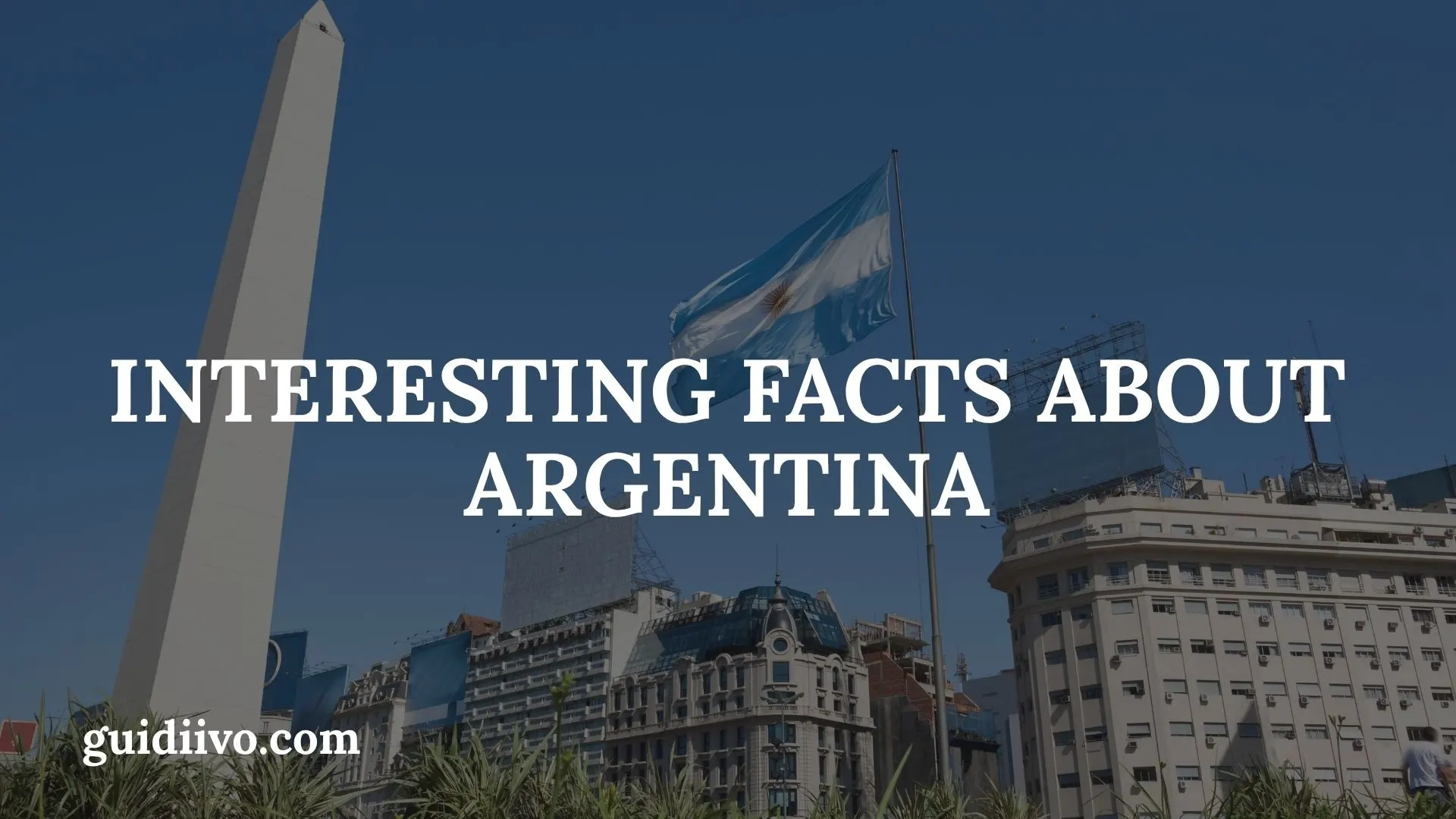
Argentina is a country of extraordinary contrasts. It stretches from subtropical forests in the north to windswept islands and glaciers in the south. Between them lie fertile grasslands, high deserts, vineyards, salt flats, wetlands, crowded cities, and some of the tallest mountains outside Asia.
The most interesting facts about Argentina are not limited to tango, soccer, and steak. Its story also includes prehistoric giants, pioneering science, Indigenous traditions, literary landmarks, dramatic political change, and natural wonders found nowhere else.
This guide explores Argentina’s geography, history, food, wildlife, language, culture, sports, economy, and modern importance. Each fact explains not only what makes the country unusual, but also why that detail matters.
Quick Answer:Interesting Facts About Argentina
Argentina is South America’s second-largest country and one of the most geographically diverse nations on Earth. It contains the Andes, the Pampas, Patagonia, Iguazú Falls, immense glaciers, rich fossil beds, and major agricultural regions. Argentina also helped shape global tango, soccer, literature, wine, beef culture, human-rights movements, and scientific research.
Quick Facts About Argentina
| Topic | Details |
| Official name | Argentine Republic |
| Location | Southern South America |
| Capital | Buenos Aires |
| Area | About 2.78 million square kilometers |
| Population | 46,044,703 in the 2022 national census |
| Administrative divisions | 23 provinces and the Autonomous City of Buenos Aires |
| Official language | Spanish at the national level |
| Currency | Argentine peso |
| Highest point | Aconcagua |
| Longest river system | Paraná–Paraguay–Río de la Plata system |
| National drink | Mate |
| National sport | Pato |
| Largest city | Buenos Aires |
| Fun fact | Argentina’s name comes from a word connected with silver |
35 Interesting Facts About Argentina
Fact 1: Argentina Is the Second-Largest Country in South America
Argentina covers about 2.78 million square kilometers, making it South America’s second-largest country after Brazil. It is also among the largest countries in the world.
Why It Matters: Its immense size explains the country’s remarkable variety of climates, landscapes, wildlife, and regional identities.
Did You Know? A trip from Argentina’s subtropical north to Tierra del Fuego can feel like traveling across several different countries.
Additional Context: The nation stretches roughly 3,700 kilometers from north to south, creating major differences in temperature and daylight.
Fact 2: The Country’s Name Is Connected to Silver
The name Argentina comes from the Latin word argentum, meaning “silver.” Early European explorers believed the region might contain vast silver riches after hearing stories about a legendary “Silver Mountain.”
Why It Matters: The name reflects how rumors, trade, and colonial ambition shaped early European interest in South America.
Did You Know? The Río de la Plata means “River of Silver,” even though it is actually a broad estuary rather than a silver-filled river.
Additional Context: The hoped-for silver deposits were not found in the region on the scale explorers imagined.
Fact 3: Argentina Contains the Highest Mountain Outside Asia
Aconcagua rises in the Andes of Mendoza Province. At approximately 6,961 meters, or 22,838 feet, it is the highest mountain in the Western Hemisphere and the highest peak outside Asia.
Why It Matters: Aconcagua is one of the Seven Summits, the highest mountains on each continent.
Did You Know? Climbers do not usually need advanced technical skills on the normal route, but altitude, cold, and storms make the journey dangerous.
Additional Context: The mountain formed through tectonic forces linked to the Nazca Plate moving beneath the South American Plate.
Fact 4: Argentina Is Home to Both Subtropical Jungles and Polar-Like Landscapes
Northern Argentina includes warm forests and wetlands, while the far south contains glaciers, subantarctic islands, and cold, stormy channels.
Why It Matters: Few countries contain such dramatic ecological variety within one national territory.
Did You Know? Visitors can see toucans near Iguazú Falls and penguins in Patagonia without leaving Argentina.
Additional Context: Elevation adds even more diversity. High Andean areas can remain cold and dry even when nearby lowlands are hot.
Fact 5: Iguazú Falls Is Made Up of Hundreds of Waterfalls
Iguazú Falls lies on the border between Argentina and Brazil. Depending on water levels, the system contains around 275 individual cascades spread across nearly three kilometers.
Why It Matters: It is one of the world’s largest and most spectacular waterfall systems.
Did You Know? Its most powerful section is called the Devil’s Throat, a deep horseshoe-shaped chasm filled with spray and roaring water.
Additional Context: Argentina’s walkways offer close views from above and below, while surrounding rainforest protects monkeys, coatis, toucans, and butterflies.
Fact 6: Patagonia Is a Region, Not a Province or Country
Patagonia covers a vast area across southern Argentina and Chile. On the Argentine side, it includes steppes, mountains, forests, coastlines, lakes, glaciers, and several provinces.
Why It Matters: Understanding Patagonia as a region helps explain its cultural and environmental diversity.
Did You Know? Some Patagonian communities trace their heritage to Welsh settlers who arrived during the 19th century.
Additional Context: The region is known for strong winds, low population density, sheep ranching, energy resources, outdoor tourism, and unique wildlife.
Fact 7: Perito Moreno Glacier Sometimes Creates a Natural Ice Dam
Perito Moreno Glacier in Los Glaciares National Park advances into a narrow channel and may block the flow of water between sections of Lake Argentino.
Why It Matters: Water pressure can eventually break through the ice, producing a dramatic natural rupture.
Did You Know? Unlike many glaciers that have steadily retreated, Perito Moreno has experienced periods of relative stability, though scientists continue to monitor changing conditions.
Additional Context: Its accessible viewing platforms allow visitors to watch enormous pieces of ice calve into the lake.
Fact 8: Argentina Holds One of the World’s Greatest Dinosaur Records
Patagonia has produced fossils of some of the largest dinosaurs ever discovered, including enormous long-necked titanosaurs. The region has also yielded remains of giant predators such as Giganotosaurus.
Why It Matters: Argentine fossil sites help scientists reconstruct the evolution and ecosystems of the Southern Hemisphere.
Did You Know? Argentinosaurus may have weighed around 70 metric tons, although exact estimates remain uncertain because its skeleton is incomplete.
Additional Context: Dry landscapes and exposed rock layers make parts of Patagonia especially valuable for paleontology.
Fact 9: Buenos Aires Is One of Latin America’s Great Cultural Capitals
Buenos Aires is known for theaters, bookstores, cafés, museums, architecture, nightlife, and neighborhood culture. European immigration strongly influenced its urban appearance, but the city developed a distinctly Río de la Plata identity.
Why It Matters: Buenos Aires has shaped Spanish-language publishing, music, theater, journalism, and political thought.
Did You Know? Residents of the city are commonly called porteños, meaning people of the port.
Additional Context: Palermo, San Telmo, La Boca, Recoleta, and other neighborhoods have their own histories and atmospheres.
Fact 10: Buenos Aires Has One of the World’s Most Famous Bookstores
El Ateneo Grand Splendid occupies a former theater built in the early 20th century. Its balconies, painted ceiling, stage, and decorative boxes remain part of the bookstore.
Why It Matters: The building shows how historic architecture can be reused while preserving cultural memory.
Did You Know? The former stage now serves as a café, allowing visitors to read where performers once appeared.
Additional Context: Argentina’s strong literary culture has produced major authors, publishers, translators, and devoted readers.
Fact 11: Tango Developed in Both Argentina and Uruguay
Tango emerged during the late 19th century in the urban communities of Buenos Aires and Montevideo. It blended African, European, and local influences through music, dance, poetry, and social life.
Why It Matters: Tango reflects migration, cultural exchange, working-class experience, longing, and urban identity.
Did You Know? UNESCO added the Argentine and Uruguayan tradition of tango to its Intangible Cultural Heritage list in 2009.
Additional Context: Tango is not simply a dance. It is also a musical style, lyrical tradition, and global social culture.
Fact 12: The Bandoneón Gave Tango Its Distinctive Sound
The bandoneón is a button-operated bellows instrument closely associated with tango. It was developed in Germany before reaching the Río de la Plata region through migration and trade.
Why It Matters: Its mournful, breathing sound became central to tango’s emotional character.
Did You Know? The instrument was not originally designed for tango and was initially connected with religious and folk music in Europe.
Additional Context: Argentine composer Astor Piazzolla later used the bandoneón to transform tango through jazz and classical influences.
Fact 13: Argentine Spanish Has a Distinct Pronoun System
In much of Argentina, people use vos instead of tú for the informal singular “you.” This feature is known as voseo.
Why It Matters: It changes pronouns and verb forms, making Argentine Spanish immediately recognizable.
Did You Know? Instead of tú tienes, many Argentines say vos tenés. Instead of tú eres, they say vos sos.
Additional Context: Buenos Aires speech also often pronounces “ll” and “y” with a sound similar to “sh” or the “s” in “measure.”
Fact 14: Lunfardo Grew From Buenos Aires Street Life
Lunfardo is a vocabulary tradition linked to Buenos Aires and the Río de la Plata. It developed through contact among Spanish speakers, Italian immigrants, workers, prisoners, musicians, and neighborhood communities.
Why It Matters: Many Lunfardo words entered everyday Argentine speech and tango lyrics.
Did You Know? Laburo, meaning work, is connected to the Italian word lavoro.
Additional Context: Lunfardo was once treated as criminal slang, but it is now recognized as a rich expression of urban culture and linguistic creativity.
Fact 15: Mate Is More Than a Drink
Mate is an infusion made from dried yerba mate leaves. People commonly drink it from a gourd through a filtered metal straw called a bombilla.
Why It Matters: Sharing mate represents trust, conversation, hospitality, and social connection.
Did You Know? One person usually prepares and refills the mate, passing it to each participant in turn.
Additional Context: The tradition has Indigenous Guaraní roots and is shared across Argentina, Uruguay, Paraguay, southern Brazil, and neighboring regions.
Fact 16: Argentina’s National Sport Is Pato, Not Soccer

Soccer is the country’s most popular sport, but Argentina’s official national sport is pato. The modern game combines elements of polo and basketball and is played on horseback.
Why It Matters: Pato preserves a rural tradition connected to the gauchos and the Pampas.
Did You Know? The word pato means “duck.” Early versions reportedly used a live duck, but the modern sport uses a handled leather ball.
Additional Context: Safety rules, organized fields, and standardized equipment transformed it into a regulated competitive sport.
Fact 17: Soccer Functions as a Powerful Social Language
Soccer in Argentina crosses class, regional, and generational lines. Clubs often represent neighborhoods, family traditions, and deeply held identities.
Why It Matters: Matches can express local pride, community belonging, and national emotion in ways that go far beyond entertainment.
Did You Know? Argentina won the men’s FIFA World Cup in 1978, 1986, and 2022.
Additional Context: Diego Maradona and Lionel Messi became global figures, but local club culture remains the foundation of Argentine soccer passion.
Fact 18: The Superclásico Is One of Soccer’s Fiercest Rivalries
The match between Buenos Aires clubs Boca Juniors and River Plate is called the Superclásico.
Why It Matters: The rivalry reflects history, neighborhood identity, sporting success, and contrasting public images associated with the clubs.
Did You Know? Boca’s stadium, La Bombonera, is famous for its steep stands and intense atmosphere.
Additional Context: Although both clubs have supporters across Argentina and abroad, their rivalry grew from shared origins in Buenos Aires before River later moved north to Núñez.
Fact 19: The Pampas Helped Make Argentina an Agricultural Power
The Pampas are broad, fertile plains in central Argentina. Their deep soils and moderate climate support crops, livestock, transportation, and major cities.
Why It Matters: Grain and cattle production became central to Argentina’s economic growth and global trade.
Did You Know? The landscape appears almost completely flat in many areas, allowing the sky to dominate the view.
Additional Context: Soybeans, corn, wheat, sunflower products, and beef remain important, although farming practices and environmental pressures continue to change.
Fact 20: The Gaucho Became a National Cultural Symbol
Gauchos were skilled horsemen who worked across the grasslands of Argentina, Uruguay, and southern Brazil. They herded cattle, traveled long distances, and developed distinctive clothing, tools, music, and customs.
Why It Matters: The gaucho represents independence, rural knowledge, courage, and freedom in Argentine culture.
Did You Know? The epic poem Martín Fierro turned the gaucho into one of the country’s most important literary figures.
Additional Context: Real gaucho life was often difficult, insecure, and shaped by conflict over land and authority.
Fact 21: Asado Is a Social Ritual, Not Simply Barbecue
Asado refers both to grilled food and the gathering built around it. Beef cuts, sausages, ribs, sweetbreads, vegetables, and other foods may cook slowly over wood or charcoal.
Why It Matters: The meal creates time for family, friendship, storytelling, and shared responsibility.
Did You Know? The person managing the fire and meat is called the asador.
Additional Context: Techniques vary by region. Patagonia is known for whole lamb cooked beside an open fire, while urban households often use metal grills called parrillas.
Fact 22: Argentina Is One of the World’s Major Wine Producers
Wine production is concentrated along the dry eastern side of the Andes, especially in Mendoza, San Juan, Salta, and parts of Patagonia.
Why It Matters: High elevations, strong sunlight, cool nights, and controlled irrigation help produce distinctive grapes.
Did You Know? Malbec came from France but became internationally associated with Argentina.
Additional Context: Some vineyards in Salta grow at elevations above 2,000 meters. Argentina also produces Torrontés, Cabernet Sauvignon, Bonarda, Chardonnay, and many other varieties.
Fact 23: Italian Immigration Transformed Argentine Food and Speech
Millions of Italians migrated to Argentina during the late 19th and early 20th centuries. Their influence appears in family names, gestures, vocabulary, music, architecture, and cuisine.
Why It Matters: Modern Argentine identity developed through interaction among Indigenous peoples, colonial populations, Africans, Europeans, and later immigrant communities.
Did You Know? Pizza, pasta, gnocchi, gelato, and milanesa are deeply embedded in everyday Argentine food culture.
Additional Context: Argentine Spanish rhythm and intonation are sometimes compared with Italian speech, especially in Buenos Aires.
Fact 24: Gnocchi Is Traditionally Eaten on the 29th
Many Argentines eat gnocchi, known as ñoquis, on the 29th day of each month.
Why It Matters: The custom connects food with family tradition, hope, thrift, and good fortune.
Did You Know? Some diners place money under the plate to attract prosperity for the coming month.
Additional Context: One explanation links the practice to households needing an inexpensive meal near the end of the month. Its exact history is debated, but the custom remains popular.
Fact 25: Argentina Has a Large Community of Welsh Heritage
Welsh settlers founded communities in Patagonia beginning in 1865. Their descendants helped establish towns in the Chubut Valley and maintained elements of Welsh language and culture.
Why It Matters: This history adds another layer to Patagonia’s multicultural identity.
Did You Know? Towns such as Gaiman are known for Welsh-style tea houses, chapels, and cultural festivals.
Additional Context: The settlers faced severe environmental challenges and built relationships, including trade and knowledge exchange, with Indigenous Tehuelche communities.
Fact 26: Argentina Was a Pioneer in Fingerprint Identification
In 1892, an Argentine criminal investigation used fingerprints to identify Francisca Rojas in a murder case. Juan Vucetich had developed a practical fingerprint classification system while working in Argentina.
Why It Matters: The case became an important milestone in forensic identification.
Did You Know? A bloody fingerprint on a door helped investigators connect Rojas to the crime.
Additional Context: Fingerprinting later became widely used by police, border services, governments, and civil identification systems around the world.
Fact 27: Argentina Has Produced Several Nobel Prize Winners
Argentina has a distinguished history in science, diplomacy, and human-rights advocacy. Nobel laureates connected to the country include Bernardo Houssay, Luis Federico Leloir, César Milstein, Carlos Saavedra Lamas, and Adolfo Pérez Esquivel.
Why It Matters: Their achievements cover medicine, chemistry, peacebuilding, and international relations.
Did You Know? Houssay became the first Latin American scientist to receive a Nobel Prize in the sciences.
Additional Context: Argentina’s public universities and research institutions have played major roles despite recurring economic and political difficulties.
Fact 28: Public Universities Have Shaped National Life
Argentina has a strong tradition of public higher education. The University of Buenos Aires, founded in 1821, has educated influential scientists, physicians, writers, lawyers, economists, and political leaders.
Why It Matters: Broad access to higher education has supported social mobility and intellectual life.
Did You Know? Several Argentine Nobel laureates studied or taught at the University of Buenos Aires.
Additional Context: The university system has also been a center of political debate, student movements, scientific research, and public service.
Fact 29: Argentina Helped Lead Global Forensic Anthropology
The Argentine Forensic Anthropology Team was founded in the 1980s to investigate people who disappeared during the country’s military dictatorship.
Why It Matters: Its experts developed methods for identifying remains and documenting human-rights abuses.
Did You Know? The team has worked in countries across Latin America, Africa, Europe, Asia, and the Middle East.
Additional Context: Its work combines archaeology, anthropology, genetics, witness testimony, and legal evidence to restore identities and support families seeking truth.
Fact 30: The Mothers of Plaza de Mayo Changed Human-Rights Activism
During Argentina’s 1976–1983 dictatorship, mothers of missing people began gathering in Buenos Aires’ Plaza de Mayo to demand information about their children.
Why It Matters: Their public courage challenged enforced disappearance, censorship, and state terror.
Did You Know? White headscarves became their most recognizable symbol.
Additional Context: Their activism helped keep international attention on the disappeared. Argentina’s later trials and memory initiatives became influential examples of transitional justice.
Fact 31: The Southern Right Whale Returns to Argentina’s Coast
Southern right whales gather around Península Valdés and nearby Patagonian waters to mate, give birth, and raise calves.
Why It Matters: Their return demonstrates the value of legal protection and marine conservation.
Did You Know? The whales often swim close enough to shore to be seen without a boat.
Additional Context: Península Valdés also supports sea lions, elephant seals, orcas, penguins, guanacos, rheas, and many seabirds.
Fact 32: Argentine Orcas Use a Rare Hunting Technique
Some orcas near Península Valdés intentionally surge onto beaches to catch young sea lions and elephant seals.
Why It Matters: The behavior shows advanced learning, timing, coordination, and adaptation.
Did You Know? The technique is dangerous because an orca can become stranded if it misjudges the wave or slope.
Additional Context: Younger animals appear to learn by watching experienced hunters, suggesting that the behavior is culturally transmitted within certain family groups.
Fact 33: The Iberá Wetlands Are Among South America’s Great Freshwater Ecosystems
The Iberá Wetlands in Corrientes Province contain marshes, lagoons, floating vegetation, grasslands, and forests.
Why It Matters: They provide habitat for capybaras, caimans, marsh deer, giant anteaters, birds, and many other species.
Did You Know? Conservation projects have reintroduced locally lost animals, including jaguars and giant otters.
Additional Context: Rewilding can restore ecological relationships while supporting tourism and local employment, but it requires long-term monitoring and community participation.
Fact 34: Argentina Is Important to the Global Energy Transition
Northwestern Argentina forms part of the Lithium Triangle with Bolivia and Chile. The country also has major copper prospects and renewable-energy potential.
Why It Matters: Lithium and copper are essential for batteries, electrical systems, and low-carbon technologies.
Did You Know? The OECD reported that Argentina holds about 20% of the world’s identified lithium resources.
Additional Context: Development creates economic opportunities but also raises serious questions about water use, ecosystems, infrastructure, and Indigenous consultation.
Fact 35: Antarctica Plays a Major Role in Argentina’s National Outlook
Argentina has maintained a long-standing presence in Antarctica and operates scientific stations there. It also claims a sector of the continent, although Antarctic territorial claims are governed by the international treaty system.
Why It Matters: Antarctic research supports climate science, biology, geology, oceanography, and weather observation.
Did You Know? Ushuaia is a major departure point for ships traveling to the Antarctic Peninsula.
Additional Context: Argentina’s southern geography strongly influences its scientific, diplomatic, maritime, and environmental interests.
Timeline of Important Events in Argentine History
| Date | Milestone |
| Before the 1500s | Diverse Indigenous societies inhabit the region, including Guaraní, Diaguita, Mapuche, Qom, Wichí, and many others |
| 1516 | Spanish explorer Juan Díaz de Solís reaches the Río de la Plata |
| 1580 | Buenos Aires is permanently refounded |
| 1810 | The May Revolution begins the break from Spanish colonial rule |
| July 9, 1816 | Independence is formally declared |
| 1853 | A national constitution is adopted |
| 1880–1914 | Large-scale European immigration transforms society |
| 1912 | Universal, secret, compulsory male voting is established |
| 1947 | Women gain national voting rights |
| 1976–1983 | Military dictatorship carries out widespread repression and enforced disappearances |
| 1983 | Democracy returns |
| 2001–2002 | A severe economic and political crisis affects the country |
| 2009 | Tango receives UNESCO intangible heritage recognition |
| 2022 | Argentina wins its third men’s FIFA World Cup |
Argentina Statistics
| Statistic | Figure |
| Land area | Approximately 2.78 million km² |
| 2022 census population | 46,044,703 |
| Provinces | 23 |
| Autonomous federal district | 1 |
| Highest mountain | Aconcagua, about 6,961 m |
| Approximate north-to-south length | 3,700 km |
| Men’s FIFA World Cup titles through 2022 | 3 |
| Individual cascades at Iguazú Falls | Around 275, depending on water flow |
| Continental coastline | More than 4,700 km |
| UNESCO inscription year for tango | 2009 |
Myth vs. Fact About Argentina
| Myth | Fact |
| Everyone in Argentina dances tango | Tango is culturally important, but most people do not regularly dance it |
| Argentina is tropical | The country includes tropical, temperate, arid, alpine, and subantarctic climates |
| Buenos Aires represents the whole country | Argentina has strong regional identities, accents, foods, and traditions |
| Soccer is the official national sport | Pato is the official national sport, although soccer is far more popular |
| Patagonia is a province | Patagonia is a broad region spanning southern Argentina and Chile |
| Argentine culture is entirely European | Indigenous, African, European, Middle Eastern, Asian, and Latin American influences all contributed |
| All Argentine food centers on beef | Pasta, pizza, empanadas, corn dishes, stews, seafood, and regional Indigenous foods are also important |
| Argentina has one uniform Spanish accent | Pronunciation and vocabulary differ across regions |
Common Misconceptions About Argentina
Argentina Is Not Culturally Uniform
Buenos Aires receives much international attention, but it cannot represent the entire nation. Northwestern traditions differ from those of the Pampas, Cuyo, Mesopotamia, Córdoba, Patagonia, and the northeast. Music, food, ancestry, climate, and speech change significantly by region.
Indigenous Peoples Are Not Only Part of the Past
Argentina’s Indigenous communities remain active parts of modern society. They maintain languages, cultural traditions, political organizations, and relationships with ancestral territories. Discussions about land, education, resource extraction, and cultural recognition continue today.
The Country Is More Than Tango and Soccer
Tango and soccer are important, but Argentina has also made major contributions to medicine, chemistry, literature, film, agriculture, astronomy, nuclear research, paleontology, music, human-rights law, and Antarctic science.
Why Argentina Matters Today
Argentina matters because its natural and human resources connect it to several global challenges. Its farms contribute to food supplies, while its lithium and copper resources may support new energy technologies. Its glaciers, wetlands, forests, grasslands, and seas are important to biodiversity and climate research.
The country also offers lessons in democracy and historical memory. Its human-rights organizations helped develop international methods for investigating disappearances and identifying victims.
Culturally, Argentina continues to influence global soccer, music, film, literature, food, and design. Its achievements coexist with economic instability and social inequality, making it a valuable case study in both national potential and institutional challenge.
Related Discoveries and Concepts
Argentina connects naturally with several wider topics:
- The Andes: A mountain chain shaping climate, water, mining, settlement, and agriculture.
- The Río de la Plata: An estuary linking Argentina and Uruguay through trade and shared culture.
- The Gran Chaco: A biologically rich but threatened lowland region.
- The Lithium Triangle: A high-altitude zone shared with Bolivia and Chile.
- Gondwana fossils: Evidence of ancient southern ecosystems and continental change.
- Antarctic science: Research into climate, oceans, ice, wildlife, and Earth history.
- Río de la Plata culture: A shared regional identity visible in tango, mate, language, and food.
Expert Insights: How to Understand Argentina Beyond the Facts
The best way to understand Argentina is to think regionally. Geography has shaped nearly every part of national life.
The Andes influence irrigation, wine, mining, and international borders. The Pampas support agriculture and major population centers. Atlantic waters sustain fisheries and marine ecosystems. Northern forests and wetlands hold exceptional biodiversity. Patagonia combines tourism, energy, ranching, fossils, and conservation.
History is equally important. Argentina’s modern identity cannot be explained through European immigration alone. Indigenous peoples, Afro-Argentines, neighboring Latin American cultures, and later migration all contributed.
Finally, avoid treating Argentina’s economic difficulties as its only story. Economic instability has had deep social consequences, but the country also has resilient institutions, research traditions, productive capacity, cultural creativity, and active civic organizations.
Frequently Asked Questions About Argentina
What is Argentina best known for?
Argentina is best known internationally for tango, soccer, Lionel Messi, Diego Maradona, Malbec wine, beef, mate, Patagonia, Iguazú Falls, and Buenos Aires. It is also important for dinosaur fossils, Antarctic research, agriculture, literature, human-rights movements, and some of the world’s largest lithium resources.
What is the capital of Argentina?
Buenos Aires is Argentina’s capital and largest city. It is legally organized as the Autonomous City of Buenos Aires rather than belonging to Buenos Aires Province. The city serves as the nation’s main political, cultural, financial, publishing, and transportation center.
What language do people speak in Argentina?
Spanish is the main language and the language used by the national government. Argentine Spanish often uses vos instead of tú and has distinctive pronunciation. Indigenous languages such as Guaraní, Quechua, Qom, Wichí, and Mapudungun are also spoken, along with immigrant languages.
Why is Argentina called Argentina?
The name comes from the Latin argentum, meaning silver. Early explorers heard stories about silver riches in the interior of South America. The same idea appears in the name Río de la Plata, which means River of Silver.
Is Argentina safe for tourists?
Millions of people visit Argentina successfully, but conditions vary by location and can change. Travelers should watch for pickpocketing, bag theft, transportation disruptions, demonstrations, and outdoor hazards. Current official travel guidance, local advice, insurance, and standard urban precautions are recommended.
When is the best time to visit Argentina?
The best time depends on the destination. Spring and fall are pleasant in Buenos Aires and central regions. Summer suits much of Patagonia but is busier. Winter supports Andean skiing. Iguazú remains warm throughout the year, while northwestern desert regions can have strong seasonal temperature changes.
What is Argentina’s national food?
Argentina does not have one universally official national dish. Asado is often treated as the country’s signature meal because of its deep social importance. Empanadas, locro, milanesa, choripán, pasta, pizza, dulce de leche, and mate are also central to Argentine food culture.
Is Patagonia entirely in Argentina?
No. Patagonia is shared by Argentina and Chile. Argentine Patagonia occupies the larger eastern portion and includes extensive plateaus, Atlantic coastline, Andean forests, lakes, glaciers, and parts of Tierra del Fuego. Chilean Patagonia is narrower, wetter, more mountainous, and marked by fjords and islands.
Why is Argentina important for dinosaurs?
Patagonia contains exposed sedimentary rocks from periods when dinosaurs lived across the ancient southern continents. Scientists have found huge titanosaurs, giant meat-eating dinosaurs, eggs, nests, footprints, plants, and small animals. These discoveries help explain dinosaur growth, movement, behavior, and evolution.
What makes Argentine culture unique?
Argentine culture grew from Indigenous foundations, Spanish colonization, African presence, regional Latin American connections, and large waves of immigration. The result is visible in its language, mate rituals, tango, folk music, soccer, literature, cafés, family customs, food, humor, and strong regional identities.
Key Takeaways
- Argentina is South America’s second-largest country.
- Its landscapes range from subtropical forests to glaciers and subantarctic islands.
- Aconcagua is the highest mountain outside Asia.
- Patagonia has produced fossils of some of the largest dinosaurs known.
- Tango developed in both Buenos Aires and Montevideo.
- Mate is a shared social ritual with Indigenous roots.
- Pato, not soccer, is Argentina’s official national sport.
- The Pampas helped establish Argentina as a major agricultural producer.
- Immigration deeply influenced Argentine food, language, and city life.
- Argentina has made important contributions to science, forensics, literature, and human rights.
- Its lithium, copper, food production, wetlands, and Antarctic research give it modern global importance.
- Argentine identity is diverse and cannot be reduced to Buenos Aires, beef, tango, or soccer.
Conclusion
The most interesting facts about Argentina reveal a country shaped by scale, contrast, movement, and reinvention. It holds tropical forests, dry salt flats, fertile plains, towering Andes peaks, fossil-rich deserts, immense glaciers, and wildlife-filled coasts.
Its culture is equally layered. Indigenous heritage, migration, rural traditions, urban creativity, scientific ambition, political struggle, and shared rituals have all left their mark.
Argentina deserves attention not simply because it produces famous athletes, wine, tango, and beef, but because its geography, history, culture, and natural resources help explain some of the most important stories in South America and the wider world.

I am Theodore Blake, a writer driven by curiosity and a lifelong love of discovery. I enjoy exploring surprising facts about animals, science, history, and the natural world. Through my writing, I aim to make knowledge simple, enjoyable, and memorable while inspiring readers to see familiar subjects from new perspectives.
Books
1. The Curious World: Extraordinary Facts Explained
A fascinating collection of unusual facts about nature, science, history, and everyday life, written to entertain curious readers.
2. Hidden Wonders: Stories Behind Amazing Facts
This book explores surprising discoveries and little-known stories that reveal how extraordinary our world truly is.