Animals can fly without feathers, survive without food for years, communicate through vibrations, and even rebuild parts of their bodies. The most interesting facts about animals are not merely strange pieces of trivia. They reveal how evolution has shaped living creatures to solve problems involving survival, movement, communication, reproduction, and extreme environments.
From an octopus with three hearts to elephants that communicate through the ground, the animal kingdom contains abilities that can seem almost impossible. This guide explores remarkable mammals, birds, reptiles, amphibians, fish, insects, and marine animals while explaining why each ability matters.
Quick Answer: Interesting Facts About Animals
Animals possess extraordinary adaptations that help them survive. Octopuses have three hearts, dolphins rest one brain hemisphere at a time, axolotls regenerate body parts, and birds can sense Earth’s magnetic field. These features developed over generations because they improved feeding, movement, protection, communication, or reproduction within particular environments.
Quick Facts About the Animal Kingdom
| Topic | Details |
| Biological kingdom | Animalia |
| Known diversity | More than 1.5 million animal species have been formally described |
| Main habitats | Oceans, freshwater, forests, grasslands, deserts, caves, soil, polar regions, and cities |
| Largest living animal | Blue whale |
| Largest land animal | African bush elephant |
| Smallest animals | Some microscopic invertebrates measure less than one millimeter |
| Oldest animal groups | Sponges and other early animal lineages appeared hundreds of millions of years ago |
| Longest-lived vertebrates | Greenland sharks may live for several centuries |
| Most diverse animal group | Arthropods, especially insects |
| Fun fact | Scientists continue to identify thousands of previously unknown animal species |
1. Octopuses Have Three Hearts and Blue Blood
An octopus has three hearts. Two pump blood through the gills, while the third sends oxygen-rich blood around the body. Its blood appears blue because it uses copper-based hemocyanin rather than iron-based hemoglobin to carry oxygen.
Why it matters: Hemocyanin works effectively in cold, low-oxygen seawater, helping octopuses survive in demanding marine environments.
Did you know? The main heart temporarily stops beating when an octopus swims, which may help explain why many octopuses prefer crawling along the seafloor.
2. Blue Whales Are the Largest Animals Known to Have Lived
Blue whales can exceed 90 feet in length and weigh well over 100 tons. They are larger than every known dinosaur by body mass, making them the largest animals identified in Earth’s history.
Why it matters: Their size shows how productive marine food webs can support enormous organisms.
Did you know? Despite their size, blue whales mainly eat tiny crustaceans called krill. They filter huge quantities of seawater through baleen plates instead of hunting large prey.
3. Dolphins Can Rest Half of Their Brain at a Time
Dolphins use unihemispheric sleep, meaning one half of the brain rests while the other remains alert. The active hemisphere helps control breathing, watch for danger, and maintain contact with the group.
Why it matters: Unlike humans, dolphins must consciously return to the surface to breathe. Complete unconsciousness underwater could be deadly.
Did you know? One eye often remains open during this resting period, usually opposite the active brain hemisphere.
4. Elephants Can Communicate Through the Ground
Elephants produce very low-frequency calls known as infrasound. Some of these sounds travel through the air, while vibrations can also move through the ground. Other elephants may detect them through sensitive tissues in their feet and trunks.
Why it matters: This system allows widely separated herd members to exchange warnings, coordinate movement, and locate potential mates.
Did you know? Because low frequencies travel far, an elephant’s message may reach animals several miles away under favorable conditions.
5. Crows Can Remember Human Faces
Crows can distinguish between individual human faces and remember people associated with danger. Research has shown that they may react to a threatening person years after the original encounter.
Why it matters: Facial recognition allows crows to avoid repeated risks in complex urban and wild environments.
Did you know? Crows can also pass information socially. Birds that never experienced the original threat may learn to recognize a dangerous person by watching the reactions of other crows.
6. Axolotls Can Regrow Complex Body Parts
Axolotls can regenerate limbs, sections of the spinal cord, parts of the heart, and some other tissues with limited scarring. Instead of simply closing a wound, their cells form a structure that guides the rebuilding process.
Why it matters: Scientists study axolotls to understand tissue repair, nerve recovery, and the biological limits of regeneration.
Did you know? Axolotls retain juvenile aquatic features, including external gills, throughout adulthood. This condition is known as neoteny.
7. Tardigrades Can Survive Extreme Conditions
Tardigrades, often called water bears, are microscopic animals capable of entering a nearly inactive state called cryptobiosis. During this state, they lose most of their body water and dramatically reduce metabolic activity.
Why it matters: Cryptobiosis helps them survive freezing, dehydration, radiation, and other conditions that would kill most animals.
Did you know? Tardigrades are not truly indestructible. They survive extremes best while dormant, and prolonged exposure can still cause fatal damage.
8. Mantis Shrimp Strike With Extraordinary Speed
Some mantis shrimp use club-shaped appendages to hit prey with extremely rapid acceleration. The strike can crack snail shells, damage crab armor, and produce collapsing bubbles in the water.
Why it matters: These cavitation bubbles release additional energy when they implode, meaning prey may experience both the physical strike and a secondary shock.
Did you know? Researchers study mantis shrimp structures when designing impact-resistant materials because their clubs repeatedly withstand enormous forces.
9. Honeybees Dance to Share Directions
A honeybee that discovers a valuable food source can perform a waggle dance inside the hive. The dance communicates the direction and approximate distance of flowers relative to the sun.
Why it matters: This behavior allows a colony to send workers efficiently toward changing food sources.
Did you know? The bee adjusts the angle of its dance as the sun moves across the sky. This shows that the dance is not random excitement but a flexible communication system.
10. Some Frogs Can Partly Freeze Without Dying
Wood frogs survive winter by allowing large portions of their body water to freeze. Their heartbeat and breathing may stop temporarily while protective chemicals reduce damage to cells.
Why it matters: Glucose and other compounds act like biological antifreeze, helping protect delicate tissues from ice formation and dehydration.
Did you know? When temperatures rise, the frog thaws, its heart resumes beating, and it becomes active again. This adaptation allows it to inhabit extremely cold northern regions.
11. A Chameleon Changes Color for More Than Camouflage
Chameleons change color through specialized skin cells containing tiny structures that reflect light. Temperature, mood, social signals, health, and aggression may all influence the resulting colors.
Why it matters: Color change provides a visual language. A chameleon may darken when stressed or display bright patterns during a territorial or courtship encounter.
Did you know? Camouflage is only one purpose. Many chameleons change color most dramatically while communicating with other members of their species.
12. Sea Otters Help Protect Kelp Forests
Sea otters eat sea urchins, which feed on kelp. Where otters are abundant, they can prevent urchin populations from destroying entire kelp forests.
Why it matters: Kelp forests provide food, shelter, nursery habitat, coastal protection, and carbon storage. Sea otters therefore influence many species beyond their direct prey.
Did you know? This relationship is a classic example of a trophic cascade, in which a predator indirectly shapes plants and habitats through its effect on herbivores.
13. Wombats Produce Cube-Shaped Droppings
Wombats are famous for producing droppings with flat sides and distinct corners. The shape forms inside the intestine, where different sections of the intestinal wall contract and stretch at different rates.
Why it matters: Cubes are less likely than round droppings to roll away. Wombats use dung to mark territories and communicate their presence.
Did you know? The unusual shape is not created at the moment of release. It develops gradually as material moves through the digestive tract.
14. Owls Cannot Move Their Eyes Like Humans Do
An owl’s eyes are elongated and held firmly in bony structures, so they cannot rotate freely within their sockets. To change its view, the bird must move its head.
Why it matters: Large, forward-facing eyes provide excellent depth perception and collect light efficiently during nighttime hunting.
Did you know? Many owls can rotate their heads about 270 degrees, not a full circle. Specialized blood vessels help maintain circulation during these dramatic movements.
15. Giraffes Have the Same Number of Neck Vertebrae as Humans
A giraffe and a human usually have seven cervical vertebrae. The difference is that each giraffe neck bone is greatly elongated.
Why it matters: The long neck helps giraffes reach leaves, observe predators, and compete during fights between males.
Did you know? Pumping blood to the brain requires a powerful heart and carefully regulated circulation. Special valves and pressure-control systems help prevent sudden changes when the giraffe raises or lowers its head.
16. Some Lizards Can Reproduce Without Males
Several lizard species can reproduce through parthenogenesis, a process in which embryos develop from unfertilized eggs. Some whiptail lizard species consist entirely of females.
Why it matters: Parthenogenesis allows rapid reproduction when mates are absent, but it may reduce genetic diversity.
Did you know? Female-only whiptail species still perform courtship-like behaviors. Hormonal cycles influence which individual temporarily takes each behavioral role, even though fertilization does not occur.
17. Electric Eels Are Not True Eels
Electric eels belong to the knifefish group rather than the true eel order. Specialized electric organs allow them to produce weak signals for navigation and communication and stronger discharges for defense or hunting.
Why it matters: These fish live in murky freshwater where vision may be limited. Electrical sensing helps them understand their surroundings.
Did you know? They must surface regularly to gulp air because much of their oxygen is absorbed through tissue inside the mouth.
18. Bats Are the Only Mammals Capable of Sustained Flight
Flying squirrels and sugar gliders can glide, but bats actively generate lift and thrust by flapping wings formed from stretched skin supported by elongated finger bones.
Why it matters: Powered flight lets bats reach insects, flowers, fruits, caves, and distant feeding areas unavailable to most mammals.
Did you know? Bats support ecosystems by pollinating plants, spreading seeds, and consuming insects. Their economic and ecological value extends far beyond their nighttime appearance.
19. Hummingbirds Can Fly Backward
Hummingbirds rotate their wings in a figure-eight-like pattern that produces lift during both forward and backward portions of the wingbeat. This allows hovering, sideways movement, and backward flight.
Why it matters: Precise flight helps them remain in front of flowers while extracting nectar with long bills and tongues.
Did you know? Their energy demands are enormous. Many hummingbirds enter torpor at night, temporarily lowering body temperature and metabolism to conserve fuel.
20. Sharks Are Older Than Trees
The earliest shark-like fishes appeared more than 400 million years ago. The first widely recognized trees evolved later, meaning shark ancestors were already swimming before forests resembling modern woodlands existed.
Why it matters: Sharks have survived major extinction events and dramatic environmental changes.
Did you know? Modern sharks are not unchanged prehistoric relics. Today’s species are the result of continuous evolution, with specialized forms adapted to reefs, open oceans, deep water, and coastal habitats.
21. Archerfish Knock Insects Into the Water
Archerfish hunt by shooting narrow jets of water at insects resting above the surface. They adjust their aim to account for distance, gravity, and the way light bends between air and water.
Why it matters: This hunting strategy gives the fish access to prey that most aquatic predators cannot reach.
Did you know? Young archerfish improve through experience and observation, suggesting that accurate shooting requires learning rather than being entirely automatic.
22. Penguins Have Knees Hidden Inside Their Bodies
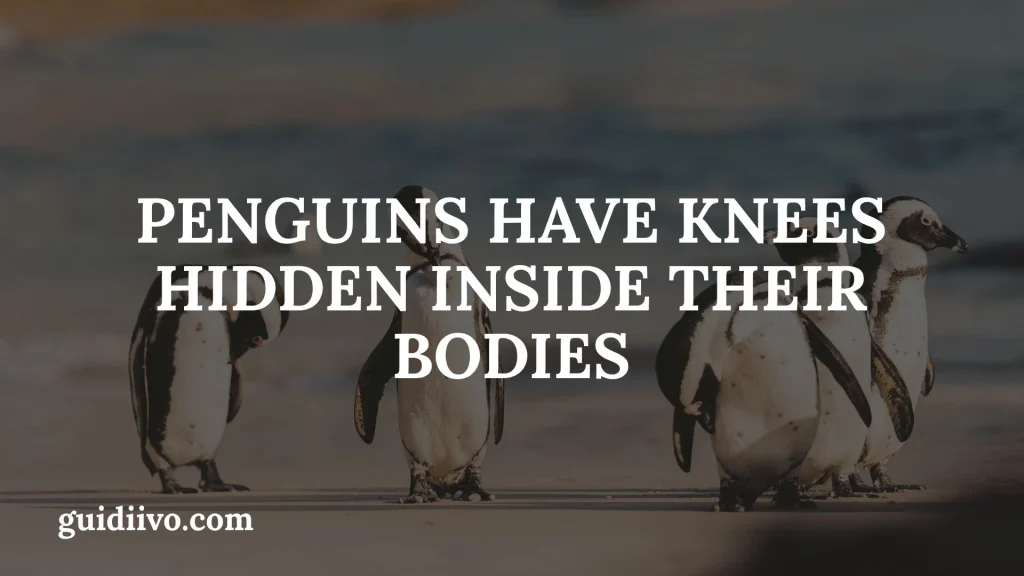
Penguins possess knees, femurs, and other leg bones similar to those of many birds. Their upper legs remain largely hidden beneath feathers and body tissue, creating the appearance of very short legs.
Why it matters: Their compact shape reduces heat loss and supports efficient swimming.
Did you know? A penguin’s familiar waddle reflects the placement of its joints and upright posture. In water, the same body becomes streamlined, with wings functioning as powerful flippers.
23. Sloths Can Host Entire Miniature Ecosystems
Sloth fur may contain algae, moths, beetles, fungi, and other organisms. Grooves and cracks in the hair trap moisture, creating a suitable microhabitat.
Why it matters: Algae may help camouflage the sloth among green leaves, although the relationships among the organisms remain complex.
Did you know? Sloths move slowly because their leafy diet provides limited energy. Their pace is an energy-saving strategy rather than laziness.
24. Male Seahorses Carry Developing Young
Female seahorses deposit eggs inside a specialized brood pouch on the male. He fertilizes them, regulates conditions inside the pouch, and later releases fully formed young.
Why it matters: Male pregnancy redistributes reproductive effort and allows females to begin producing another group of eggs sooner.
Did you know? A male may release dozens or even hundreds of babies, but most receive no parental care after birth and must survive independently.
25. Jellyfish Have No Brain, Heart, or Bones
Jellyfish are about 95 percent water and lack a centralized brain, heart, and skeleton. A simple nerve net helps them sense light, chemicals, orientation, and physical contact.
Why it matters: Their success proves that an animal does not need complex organs to survive effectively. Their basic body plan has persisted for hundreds of millions of years.
Did you know? Rhythmic muscle contractions move water through the bell, allowing the jellyfish to pulse forward.
26. Platypuses Detect Electrical Signals From Prey
A platypus closes its eyes, ears, and nostrils while diving. Receptors in its bill detect weak electrical signals created by the muscle movements of worms, crustaceans, and other prey.
Why it matters: Electroreception allows the platypus to hunt in dark or muddy water without relying on sight.
Did you know? The platypus is also an egg-laying mammal. Males possess venomous ankle spurs, adding another unusual feature to an already remarkable animal.
27. Ants Use Chemical Trails Like Living Road Signs
Many ants release pheromones that guide nestmates toward food, danger, or a new nesting location. Other ants detect these chemicals with their antennae and adjust their behavior.
Why it matters: Chemical communication allows thousands of individuals to coordinate without a central commander.
Did you know? A successful route can strengthen as more ants add pheromones. If the food disappears, the trail fades, allowing the colony to redirect its workers elsewhere.
28. Pistol Shrimp Create Powerful Underwater Bubbles
A pistol shrimp snaps one oversized claw so quickly that it fires a jet of water. The pressure change creates a cavitation bubble that collapses with intense sound, heat, and force.
Why it matters: The shrimp uses this shock to stun small prey and defend its shelter.
Did you know? The claw does not simply strike the victim. Much of the effect comes from the rapidly collapsing bubble produced a short distance away.
29. Greenland Sharks May Live for Centuries
Greenland sharks grow slowly in the cold waters of the North Atlantic and Arctic. Studies using radiocarbon dating of eye tissue suggest that some individuals may live for several hundred years.
Why it matters: Such long lives also mean slow reproduction. Populations can take an extremely long time to recover from fishing pressure.
Did you know? Estimates carry uncertainty because aging such old animals is difficult, but Greenland sharks are considered the longest-lived known vertebrates.
30. Birds May Sense Earth’s Magnetic Field
Many migratory birds appear able to detect Earth’s magnetic field and use it as part of their navigation system. Light-sensitive chemical reactions in the eye and magnetic particles in tissues have both been investigated as possible mechanisms.
Why it matters: Magnetic information can help birds maintain direction when landmarks, stars, or the sun are unavailable.
Did you know? Migration usually relies on several combined clues, including smell, polarized light, celestial patterns, inherited instructions, and learned routes.
31. Crocodiles Swallow Stones
Crocodiles sometimes swallow stones known as gastroliths. These objects may help grind food, add weight for diving, or stabilize the body in water, although their exact importance varies.
Why it matters: Crocodiles cannot chew in the way mammals do. They tear off and swallow large pieces of food.
Did you know? Stones have been found in the stomachs of many living and fossil animals, including birds, reptiles, and dinosaurs, but they may serve different purposes in different species.
32. Goats Have Rectangular Pupils
Goats, sheep, and several other grazing animals have horizontally elongated pupils. This shape provides a broad field of view across the horizon.
Why it matters: A wide view helps prey animals detect approaching predators while continuing to feed.
Did you know? Their eyes can rotate as the head moves downward, keeping the pupils aligned with the ground. Predators such as cats often have differently shaped pupils suited to judging distance during an ambush.
33. Some Snakes Can Sense Body Heat
Pit vipers, pythons, and some boas possess heat-sensitive organs that detect infrared radiation from warm objects. These structures help form a thermal picture of nearby prey.
Why it matters: Thermal sensing allows accurate strikes in darkness and helps snakes locate small mammals whose bodies are warmer than the surroundings.
Did you know? The snakes are not seeing heat exactly as humans see color. Their nervous systems combine thermal information with signals from the eyes and other senses.
34. Cleaner Fish Recognize Regular Clients
Cleaner wrasses remove parasites and dead tissue from larger fish at underwater cleaning stations. Some remember frequent visitors and behave differently depending on the client, audience, or risk of losing future business.
Why it matters: These interactions resemble a biological marketplace in which partners exchange services.
Did you know? Cleaners sometimes cheat by biting nutritious mucus instead of parasites. Client fish may punish them, leave, or choose another cleaner.
35. The Vaquita Is the World’s Most Endangered Marine Mammal
The vaquita is a small porpoise found only in the northern Gulf of California, Mexico. Its population collapsed largely because individuals became trapped and drowned in gillnets, including nets associated with illegal totoaba fishing.
Why it matters: The vaquita shows how a species can approach extinction even when people do not deliberately hunt it.
Did you know? Around 10 individuals may remain, although exact counts are difficult. Preventing gillnet deaths remains essential to its survival.
Timeline of Important Animal Discoveries
| Date or Period | Milestone |
| 4th century BCE | Aristotle produced some of the earliest systematic written studies of animals |
| 1735 | Carl Linnaeus published an early edition of Systema Naturae, helping establish modern classification |
| 1859 | Charles Darwin published On the Origin of Species |
| 1930s and 1940s | The modern evolutionary synthesis connected genetics with natural selection |
| 1960s | Jane Goodall’s chimpanzee studies transformed understanding of animal tool use and social behavior |
| 1970s | Researchers decoded major features of the honeybee waggle dance and animal communication |
| 1990s | DNA analysis became increasingly important in animal classification and conservation |
| 2000s | Tracking tags and camera traps expanded the study of migration and hidden wildlife |
| 2010s | Environmental DNA allowed scientists to detect animals from genetic material left in water or soil |
| Today | Genomics, acoustic monitoring, satellites, and machine learning help researchers study wildlife at larger scales |
Animal Statistics
| Measurement | Animal | Approximate Figure |
| Greatest body length | Blue whale | More than 90 feet |
| Greatest land-animal mass | African bush elephant | More than 6 tons in large males |
| Fastest recorded dive | Peregrine falcon | More than 200 mph |
| Longest known vertebrate lifespan | Greenland shark | Possibly 250–500 years |
| Highest bird migration | Bar-headed goose | Crosses high Himalayan regions |
| Deepest-diving mammal record | Cuvier’s beaked whale | Nearly 3,000 meters |
| Largest wingspan of a living bird | Wandering albatross | More than 11 feet |
| Smallest bird | Bee hummingbird | About 2 inches long |
| Water content of jellyfish | Many species | About 95 percent |
| Remaining vaquita population | Vaquita | Possibly around 10 |
Figures can vary among individuals, studies, species definitions, and measurement methods.
Animal Myths vs Facts
| Myth | Fact |
| Bulls become angry when they see red | Bulls respond mainly to movement, not the color red |
| Ostriches bury their heads in sand | They lower their heads near the ground to check nests or avoid detection |
| Bats are blind | Bats can see, and many also use echolocation |
| Goldfish remember things for only three seconds | Goldfish can learn routines and retain information far longer |
| Touching a baby bird makes its mother reject it | Most birds do not abandon chicks merely because a human touched them |
| Sharks never get cancer | Sharks can develop cancer and other diseases |
| Chameleons change color only for camouflage | They also change color for communication and temperature control |
| Lemmings intentionally jump from cliffs | Mass suicide is a myth; accidents can occur during migration |
| Camels store water in their humps | Humps store fat, not water |
| Daddy longlegs have deadly venom but cannot bite | This claim confuses several animals and is not scientifically accurate |
Common Misconceptions About Animals
Instinct Does Not Mean an Animal Never Learns
Instinctive behavior has a genetic foundation, but many animals refine it through practice and experience. A young predator may possess an urge to chase yet still need time to become an effective hunter.
Intelligence Is Not a Single Ranking
An animal may excel at navigation, memory, tool use, cooperation, or sensory processing. Comparing every species through human-style problem-solving creates a misleading picture of intelligence.
Evolution Does Not Aim for Perfection
Adaptations are workable solutions shaped by earlier anatomy, environmental pressures, and reproductive success. Evolution does not plan ahead or create the best imaginable design.
Dangerous Animals Are Not Automatically Aggressive
Many wild animals attack only when frightened, cornered, protecting young, defending territory, or searching for food. Respectful distance prevents many conflicts.
Why Animal Facts Matter Today
Understanding animals helps people make better decisions about agriculture, fishing, public health, land use, climate change, and conservation. Pollinators support food production, predators regulate prey populations, and decomposers recycle nutrients.
Animal research also inspires technology. Engineers study bird flight, gecko feet, whale fins, spider silk, termite mounds, and mantis shrimp clubs when designing new materials and machines. Learning about animal behavior encourages responsible wildlife tourism, safer coexistence, and greater respect for habitats that support both wildlife and human communities.
Related Discoveries Worth Exploring
Animal biology connects with evolution, ecology, genetics, paleontology, neuroscience, biomechanics, and conservation science. Important related topics include echolocation in bats and dolphins, mimicry in insects, animal migration, social learning, tool use, bioluminescence, venom evolution, camouflage, regeneration, symbiosis, and environmental DNA.
These subjects reveal that animals do not exist as isolated curiosities. Each species belongs to a network of predators, prey, competitors, parasites, microbes, plants, and physical conditions. Studying one unusual animal often leads researchers toward a much larger ecological story.
Expert Insights: How to Understand Unusual Animal Abilities
The most useful question is not simply, “What can this animal do?” It is, “What problem does this ability solve?”
Three ideas help explain remarkable animal traits:
- Adaptations come with costs. Flight offers mobility but demands energy. Armor provides protection but adds weight.
- Environment shapes usefulness. Blue blood benefits octopuses in certain marine conditions but would not automatically improve every animal.
- Behavior and anatomy work together. An owl’s eyes, neck, hearing, feathers, and hunting behavior form an integrated system.
This approach turns animal trivia into a deeper lesson about survival and evolution.
Frequently Asked Questions
What is the most interesting fact about animals?
One of the most remarkable facts is that animals have evolved many different solutions to the same problem. Birds, bats, and insects all fly, but their wings developed separately. This process, called convergent evolution, shows how similar environmental pressures can produce comparable abilities in unrelated groups.
What animal has three hearts?
Octopuses and other cephalopods have three hearts. Two branchial hearts pump blood through the gills, while one systemic heart circulates it around the body. Their blood contains copper-based hemocyanin, giving it a blue appearance and helping transport oxygen in cold marine conditions.
Which animal lives the longest?
Some ocean quahog clams live for more than 500 years. Among vertebrates, Greenland sharks are believed to have the longest known lifespan, potentially surviving for several centuries. Age estimates are challenging, so researchers usually provide ranges rather than exact maximum ages.
What is the smartest animal besides humans?
There is no single scientifically accepted winner because intelligence takes many forms. Chimpanzees, dolphins, elephants, crows, parrots, and octopuses show advanced abilities in areas such as problem-solving, memory, communication, cooperation, planning, and tool use.
Do animals understand human language?
Some animals can learn the meanings of spoken words, gestures, symbols, or commands. Dogs may recognize many object names, while apes and parrots can learn structured communication systems. However, this does not necessarily mean they understand language with the same grammar and depth as humans.
Which animal has the strongest bite?
Bite-strength comparisons depend on body size, measurement methods, and whether researchers use direct readings or estimates. The saltwater crocodile has produced the strongest directly measured bite among living animals, using powerful jaw-closing muscles to seize and crush prey.
Why do animals migrate?
Animals migrate to reach food, breeding areas, suitable temperatures, water, or safer habitats. Migration may be guided by magnetic fields, sunlight, stars, smells, landmarks, inherited behavior, and learning. The journey can involve major risks but increases access to seasonal resources.
Can animals recognize themselves in mirrors?
A limited number of species have shown behaviors interpreted as mirror self-recognition, including great apes, dolphins, elephants, and magpies. However, the mirror test favors visually oriented animals, so failure does not prove that a species lacks self-awareness.
How many animal species exist?
Scientists have formally described more than 1.5 million animal species, but the true total is much higher. Estimates differ because many small insects, deep-sea animals, parasites, and microscopic species remain undiscovered or have not yet been formally classified.
Why are insects considered animals?
Insects belong to the kingdom Animalia because they are multicellular organisms that consume organic matter, develop from embryos, and possess animal cells without rigid cell walls. They are arthropods, a large animal group that also includes spiders, crabs, centipedes, and millipedes.
Key Takeaways
- Animals use specialized anatomy, chemistry, senses, and behavior to survive.
- Octopuses have three hearts, while jellyfish have no heart or centralized brain.
- Dolphins can rest one brain hemisphere while the other remains alert.
- Some frogs freeze, axolotls regenerate tissue, and tardigrades enter cryptobiosis.
- Animal intelligence includes memory, navigation, communication, cooperation, and problem-solving.
- Predators such as sea otters can shape entire ecosystems.
- Strange traits usually solve a specific environmental or reproductive problem.
- Many familiar animal “facts” are myths or oversimplifications.
- New technologies continue to reveal previously hidden animal behavior.
- Protecting wildlife also protects food webs, habitats, and ecological services.
Conclusion
The most interesting facts about animals reveal far more than nature’s ability to surprise us. They show how living creatures adapt to cold oceans, dark caves, open skies, crowded colonies, dangerous predators, and limited food.
An octopus’s blue blood, a honeybee’s dance, or a wood frog’s frozen winter body may appear extraordinary, but each trait has a practical purpose. The closer we examine animals, the more clearly we see that every species represents a unique response to the challenges of life on Earth.